

Metallurgical Test Work Indicates Potential to Double Gold Recoveries
TORONTO, ON / ACCESS Newswire / August 19, 2026 / Wolfden Resources Corporation (WLF.V) (“Wolfden” or the “Company”) is pleased to announce that it has completed proof of concept metallurgical testing on its wholly owned Canoe Landing volcanic massive sulphide deposit in central New Brunswick (see Figure 1) where the current potential in-situ precious metal value accounts for more than 50% of the total in-situ value. Given that standard flotation processing is expected to deliver reasonably high copper, lead zinc and silver recoveries, the work focused on how to best increase the gold recoveries from the ore which typically averages about 1.0 g/t Au. The results of that test work indicate that gold recoveries can be increased from 32 to 60 percent via Bio-oxidation and thereby the potential to significantly impact the economics of this large VMS deposit.
The deposit was first discovered by Rio Tinto in the 1960’s and drilled by Noranda in the 1980’s and represents one of the largest un-developed polymetallic mineral deposits in the Bathurst mining camp. Like most VMS deposits in the Bathurst camp, there was little attention paid to recovering the precious metals due to lower metal prices and the higher costs associated with improving those recoveries. However, at current and forecast precious metal prices and using modern mineral processing techniques, the Company’s focus has been to ascertain if the project has the potential to be economically developed in one of the most supportive mining jurisdictions in North America.
|
FEBRUARY 15, 2026 – CANOE LANDING MINERAL RESOURCE STATEMENT |
||||||
|
Category |
Tonnes |
% Cu |
% Pb |
% Zn |
g/t Ag |
g/t Au |
|
Indicated |
3,693,000 |
0.52 |
0.57 |
1.71 |
32.87 |
1.04 |
|
Inferred |
17,133,000 |
0.53 |
0.61 |
1.83 |
33.73 |
0.95 |
(See additional mineral resource estimate information below)
The Company worked with the Research and Productivity Council of New Brunswick (RPC), an independent laboratory facility, on a program to largely focus on increasing precious metal recoveries using a post flotation treatment metallurgical process flow sheet. Wolfden provided RPC with 40kg of historical drill core samples that were assayed and composited to create a representative average grade of the deposit. Samples went through mill standardization, open circuit rougher testing followed by pyrite concentrate oxidation and leaching using various methods over a period of 8 months.
The flotation test work resulted in 4 concentrates produced: Copper, Lead, Zinc, and Pyrite. The pyrite concentrate containing 32.8% of the total gold, was then exposed to bio-oxidation to break down the pyrite and expose the gold grains for subsequent cyanide leaching and recovery. This work was compared to base case results as well as roasting oxidation. The resulting total process Au recovery is shown in the following table.
Table 1. Gold Recovery % – comparisons of the treatment methods including no treatment
|
Circuit Gold Recovery (%) |
|
|
Post-Flotation Treatment Method |
Gold Rec (%) |
|
No Post Flotation Treatment |
32.01 |
|
Roasting |
32.89 |
|
Bio-oxidation |
60.00 |
The test work demonstrates that Bio-oxidation post flotation treatment of a pyrite concentrate at Canoe Landing supports increased gold recoveries and net revenues for a potential mining operation. “We consider the results to be very positive and warrants the collection of drilled-fresh core samples for further metallurgical testing. This would include verification of the base metal flotation circuit as well as confirmation and improvement of the post flotation treatment for precious metals.” Stated Jeremy Ouellette, Wolfden’s Vice President of Project Development. “Our goal with this first round of testing was to identify which methods may provide improved precious metal recoveries. We would like to thank RPC and the particularly the support of Genome Atlantic in these efforts.”
Table 2 below lists the current potential unoptimized metallurgical recoveries using flotation followed by bio-oxidation. These preliminary results indicate the potential to yield a recoverable metal value of $216 tonne using the current spot prices of $ 6.51/lb copper, $1.73/lb zinc, $0.84/lb lead, $4,375.60/oz gold and $64.58/oz silver. The value includes estimated mining dilution and recoveries, but does not include any capital requirements, operating or smelting costs. Described another way, the bio-oxidation method has the potential to add an approximate additional $36/tonne in revenue at the above metal prices. These process results are preliminary and there remains further upside through more detailed optimization studies for all of the contained metals.
Table 2. Estimated Unoptimized Metallurgical Recoveries
|
Estimated Metallurgical Recoveries |
|
|
Recovered Copper |
85% |
|
Recovered Zinc |
85% |
|
Recovered Lead |
63% |
|
Recovered Gold |
60% |
|
Recovered Silver |
58% |
Bio-oxidation Methodology:
The bio-oxidation process is initiated by culturing microorganisms naturally present on the ore surface and/or in run-of-mine water. The use of site-specific microorganisms is advantageous, as these organisms are already adapted to the prevailing mineralogical, chemical, and environmental conditions. These microbes promote the oxidation of sulphide minerals to ferric iron, sulfate, and elemental sulfur, either directly at the mineral surface or indirectly via ferric iron as a strong oxidant. The overall result is extensive sulphide destruction without the need for high temperatures or pressures.
Once bio-oxidation is complete, the residue can then be treated using conventional gold recovery methods. Cyanide leaching of bio-oxidized material typically results in substantially higher gold recoveries compared to untreated feed. Relative to roasting or pressure oxidation, bio-oxidation offers lower energy requirements and reduced gaseous emissions, making it a technically and environmentally favorable pre-treatment for refractory gold ores.
Next Steps
Wolfden intends on designing a subsequent sample collection and testing program that can be used to confirm both the flotation circuit and precious metals recoveries. Future testing will focus on further increasing all metal recoveries by using fresh (unoxidized) drill core and more focused circuit chemistry using open circuit cleaner testing and closed circuit testing. Results from flotation are expected to improve the pyrite circuit gold recovery as well as minimize the mass split to the pyrite concentrate resulting in reduced capital and operating cost of the post flotation treatment circuit. In addition to further optimizing the bio-oxidation and leaching circuit, Wolfden intends on testing other technologies such as Albion and to further optimize roasting to ensure the best post-flotation treatment process is selected for future programs.
About Wolfden
Wolfden is a North American exploration and development company focused on high-margin metallic mineral deposits including precious, base, and critical metals that represent significant development projects with the potential to produce domestic supply of strategic metals.
For further information please contact Ron Little, President & CEO at (807) 624-1136.
The information in this news release has been reviewed and approved by Ron Little, P.Eng., President and CEO, and Jeremy Ouellette, VP Project Development, who are Qualified Persons under National Instrument 43-101.
Notes for Mineral Resource Estimate effective February 15, 2026 Canoe Landing:
-
Mineral Resources, which are not Mineral Reserves, do not have demonstrated economic viability. The estimate of Mineral Resources may be materially affected by environmental, permitting, legal, title, taxation, socio-political, marketing, or other relevant issues.
-
The Inferred Mineral Resource in this estimate has a lower level of confidence that that applied to an Indicated Mineral Resource and must not be converted to a Mineral Reserve. It is reasonably expected that the majority of the Inferred Mineral Resource could be upgraded to an Indicated Mineral Resource with continued exploration.
-
The Mineral Resources in this report were estimated using the Canadian Institute of Mining, Metallurgy and Petroleum (CIM), CIM Standards on Mineral Resources and Reserves, Definitions (2014) and Best Practices Guidelines (2019) prepared by the CIM Standing Committee on Reserve Definitions and adopted by the CIM Council.
-
The Mineral Resource Estimate was based on 3-year trailing average metal prices of $2,714/oz Gold, $22.59 /oz Silver, $1.33 /lb Zinc, $0.98 /lb Lead, $4.18 /lb Copper and an exchange rate of 1.36.
-
The estimate accounts for the following metals recovered and payable respectively; Gold 35%, 95%; Silver 53%, 95%; Zinc 85%, 75%; Lead 63%, 75%; Copper 85%, 75%.
-
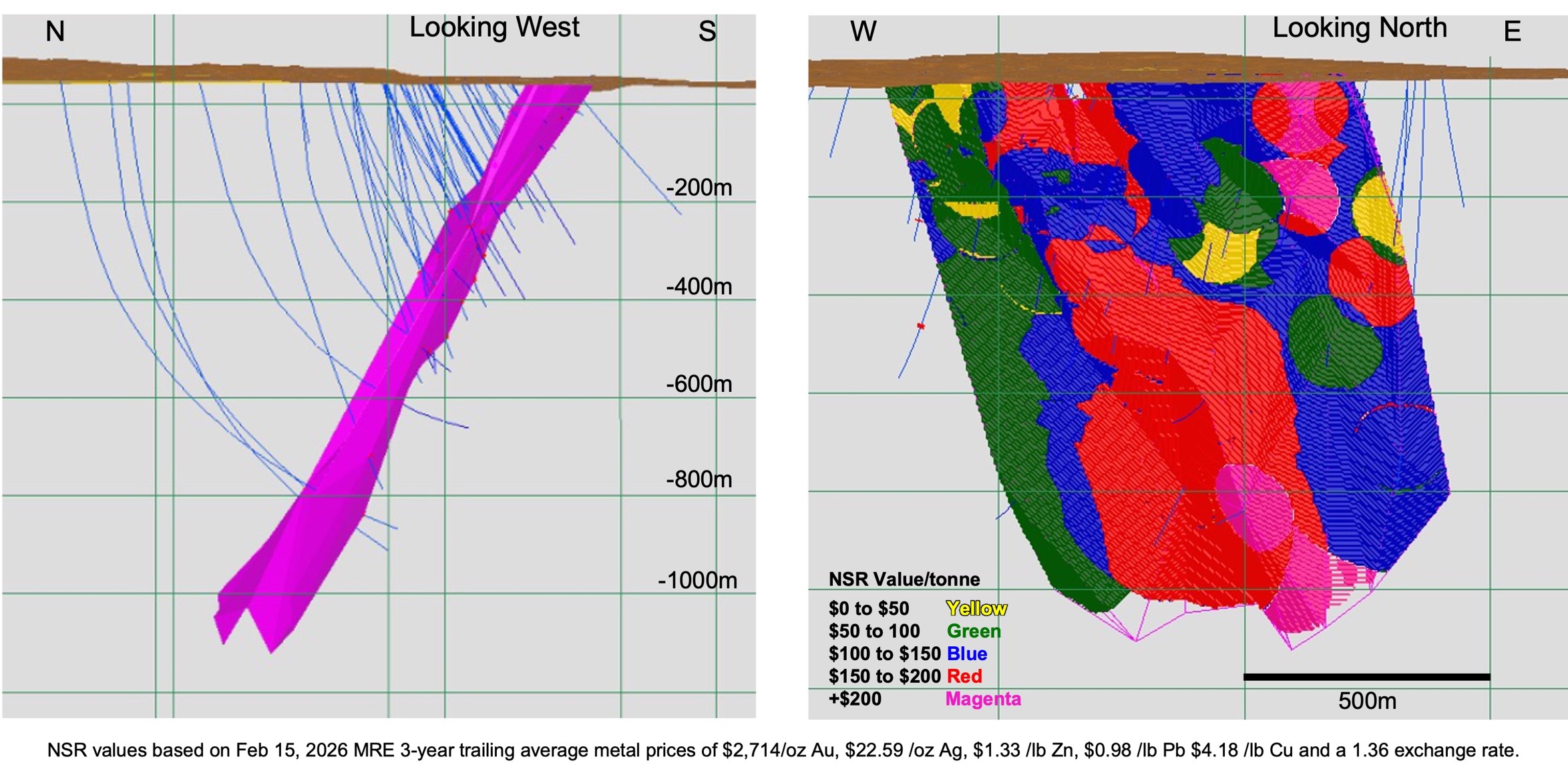
The resource estimate utilized 70 drill hole intersections that span a strike length of approximately 1 kilometre, and down to a depth 850 metres with an average true thickness of 7 metres. Indicated resources are estimated from 0 to 30 metres from a drill hole intercepts and Inferred resources from 30 to 150 metres.
-
The deposit remains open at depth and in part along strike where expansion and infill diamond drilling has the potential to further upgrade and expand the mineral resource.
Cautionary Statement Regarding Forward-Looking Information
This press release contains forward-looking information (within the meaning of applicable Canadian securities legislation) that involves various risks and uncertainties regarding future events, including the potential for projects to be domestic sources of ethically produced base and critical metals for the expansion of renewable energy in North America. Such forward-looking information includes statements based on current expectations involving a number of risks and uncertainties and such forward-looking statements are not guarantees of future performance of the Company, and include, without limitation, metal price assumptions, cash flow forecasts, permitting, land transactions, community and other regulatory approvals, and the timing and completion of exploration programs in the USA and Canada, and the respective drilling and other technical results. There are numerous risks and uncertainties that could cause actual results and the Company’s plans and objectives to differ materially from those expressed in the forward-looking information in this news release, including without limitation, the following risks and uncertainties: (i) risks inherent in the mining industry; (ii) regulatory and environmental risks; (iii) results of exploration activities and development of mineral properties; (iv) risks relating to the estimation of mineral resources; (v) stock market volatility and capital market fluctuations; and (vi) general market and industry conditions. Actual results and future events could differ materially from those anticipated in such information. This forward-looking information is based on estimates and opinions of management on the date hereof and is expressly qualified by this notice. Risks and uncertainties about the Company’s business are more fully discussed in the Company’s disclosure materials filed with the securities regulatory authorities in Canada at www.sedar.com. The Company assumes no obligation to update any forward-looking information or to update the reasons why actual results could differ from such information unless required by applicable law.
Neither TSX Venture Exchange nor its Regulation Services Provider (as that term is defined in the policies of the TSX Venture Exchange) accepts responsibility for the adequacy or accuracy of this release.
Figure 1. The Canoe Landing Deposit and past producing mines in the Bathurst Mining Camp of New Brunswick
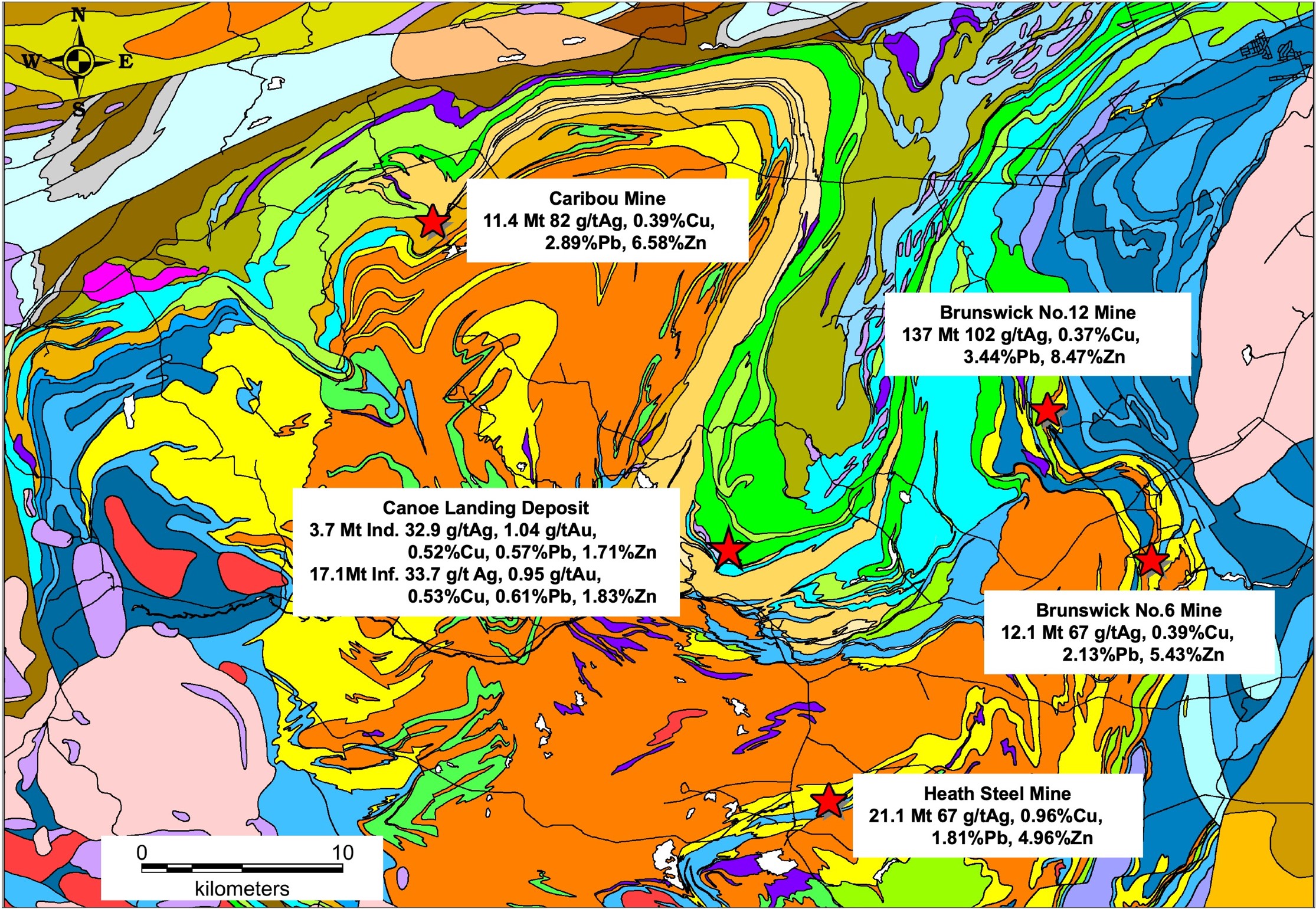
Figure 2. Canoe Landing Deposit Cross Section and Long Section
SOURCE: Wolfden Resources Corp.
View the original press release on ACCESS Newswire
Media gallery

