

Vadzo Imaging introduces the Bolt-544CRS built on the onsemi Hyperlux LP AR0544 sensor. The module resolves 5MP at 2592 x 1944 through a 1/4.2-inch rolling shutter architecture with 1.4 µm BSI pixels over 2-lane or 4-lane MIPI CSI-2. A high-performance ISP, Wake-on-Motion, enhanced Dynamic Range(eDR), and Line Interleaved HDR(LI-HDR) give OEM engineers a Low-Power Embedded Vision Camera for battery-backed nodes, always-on surveillance endpoints, and thermally constrained edge AI platforms.
FORT WORTH, TX / ACCESS Newswire / August 26, 2026 / Vadzo Imaging, a provider of embedded vision camera products for OEMs and system integrators, today announces the Bolt-544CRS. The AR0544 5MP MIPI CSI-2 Camera targets embedded designs where the imaging subsystem must run continuously inside a power envelope that conventional 5MP modules exceed. Built around the AR0544 5MP Image Sensor from the onsemi Hyperlux LP family, the module pairs sensor-level HDR processing with a Wake-on-Motion power architecture and an on-board ISP that removes demosaicing, auto exposure, and auto white balance from the host. It ships with Video4Linux2 (V4L2) Linux kernel drivers and device tree overlays validated on Raspberry Pi 4, Raspberry Pi 5, NVIDIA Jetson Orin, and NXP i.MX8M Plus.
The Power and Thermal Ceiling That Limits Always-On Embedded Vision
Many embedded vision failures at the system level are not image quality failures. They are power and thermal failures that surface as image quality problems. An outdoor node on a solar panel and a sealed battery has a daily energy budget measured in watt-hours, and a sealed IP67 enclosure on a pole dissipates heat only through its housing. In both cases, the imaging subsystem competes for the same budget as the inference accelerator, the radio, and the storage controller.
The conventional response is to reduce duty cycle. Engineers stream at low frame rates, drop resolution, or power the sensor down between scheduled captures, and each choice costs detection performance. A node sampling once every ten seconds misses the event it was deployed to capture, and a node dropping from 5MP to VGA loses the pixel density required for license plate characters or facial landmark geometry at useful standoff distances.
A second constraint compounds the first. Host-side image signal processing is expensive. Demosaicing, lens shading correction, auto exposure convergence, and white balance consume system on chip (SoC) cycles and DDR bandwidth budgeted for inference. On a Jetson Orin or an i.MX8M Plus, the ISP path and the neural accelerator share one memory controller, so bandwidth spent moving raw Bayer frames through host ISP stages is bandwidth unavailable to the model. The result runs either the model or the sensor below specification.
Inside the onsemi Hyperlux LP Architecture: ISP Offload, Motion Gated Power and Dual HDR Paths
The AR0544 belongs to the onsemi Hyperlux LP family, which was engineered around the premise that low-power imaging is a sensor architecture problem rather than a firmware scheduling problem. The onsemi Hyperlux Image Sensor line addresses this through three mechanisms that operate below the host software layer, and every module in the Onsemi Hyperlux camera portfolio inherits them.
The first is the on-board high-performance ISP. The sensor performs image signal processing internally and presents processed output to the host rather than raw Bayer data requiring a full host ISP pipeline, and auto exposure and auto white balance converge on the sensor. For an embedded designer, this changes the system arithmetic, because host ISP stages that would have consumed SoC cycles and DDR bandwidth return to the inference workload.
The second is Wake-on-Motion. The imaging core holds in super low-power (SLP) mode during inactivity and returns to full operation only when motion appears in the field of view. Activation is handled at the sensor level, so the host is not required to poll, run an idle detection routine, or manage mode transitions in software. For a battery-powered MIPI Camera node, this converts a continuous draw into an event-gated draw without adding a host-side state machine.
The third is a dual HDR path. Line Interleaved HDR acquires high-gain and low-gain rows within a single frame readout period, producing HDR reconstruction with minimal motion artifacts because the exposures are intra-frame rather than sequential. eDR extends per-pixel exposure range using on-board processing. Configured for moving subjects under wide brightness variation, the module operates as an AR0544 LI-HDR MIPI Camera, and for scenes where per-pixel range matters more than motion coherence, it operates as an eDR MIPI Camera (Enhanced Dynamic Range).
Bolt-544CRS Overview: 5MP Rolling Shutter Color Imaging Over MIPI CSI-2
The Bolt-544CRS is a board-level AR0544 Color Low Power MIPI Camera module resolving 2592 x 1944 through a 1/4.2 inch BSI rolling shutter array with 1.4 µm pixel pitch over 2-lane or 4-lane MIPI CSI-2. The AR0544 MIPI CSI-2 Camera interface removes USB enumeration overhead and network stack latency from the capture path, delivering frames with timing that USB and GigE architectures cannot match at equivalent power budgets. This is the transport layer on which the AR0544 MIPI Camera platform is built.
Optics attach through an S-Mount (M12 Standard) interface, so OEM teams select field of view and focal length without a board revision. The module operates from -30°C to +85°C, covering outdoor pole-mounted installations, unconditioned warehouse space, and sealed enclosures where internal temperature rises above ambient. As a 5MP Rolling Shutter MIPI Camera, the module suits deployments where subject motion is bounded, and the dominant constraints are power, thermal headroom, and scene dynamic range.
Key specs: 5MP (2592 x 1944) | onsemi AR0544 Hyperlux™ LP | 1/4.2 ” | 1.4 µm x 1.4 µm Pixel Size | Rolling Shutter | 2-lane or 4-lane MIPI CSI-2 | High-Performance ISP | LI-HDR and eDR | Wake-on-Motion | S-Mount (M12 Standard) | Operating Temperature -30°C to +85°C
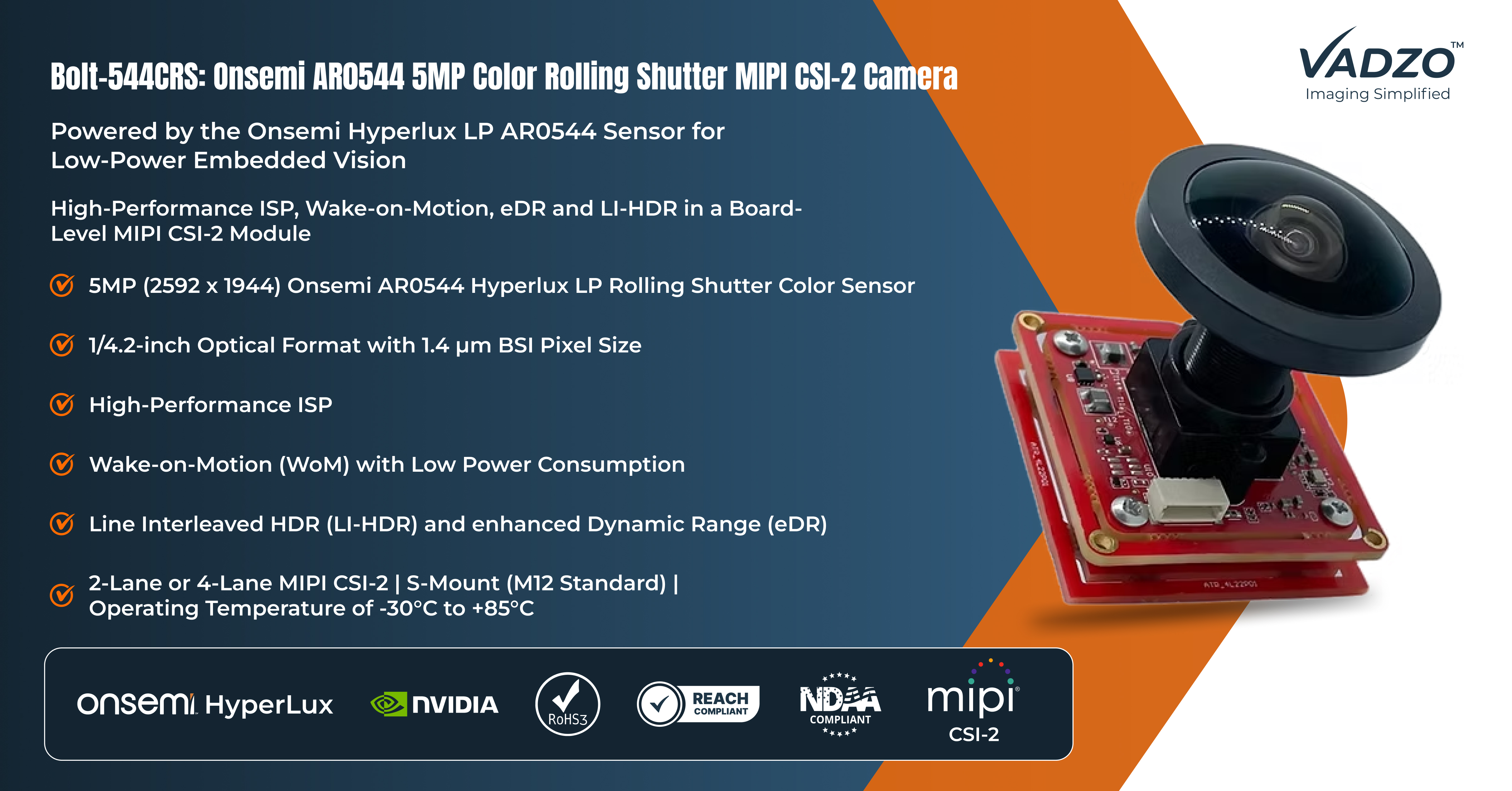
Key Capabilities of the Bolt-544CRS onsemi AR0544 5MP Low-Power MIPI CSI-2 Camera
High-Performance ISP Returns Compute Headroom to the Inference Engine: Because the AR0544 handles processing on-board and converges auto exposure and auto white balance internally, the host receives usable output without running a full ISP chain, which frees DDR bandwidth and SoC cycles for the model on Jetson Orin and i.MX8M Plus platforms. Engineers comparing an AR0544 Color MIPI Camera with a raw output alternative should measure total system power at equivalent inference throughput rather than sensor power alone, because the ISP offload is where the difference appears. It is also why an AR0544 Low Power HDR MIPI Camera behaves predictably as a Low Power Edge AI Camera where the accelerator and the imaging path share one memory controller.
Wake-on-Motion and Super Low-Power Mode for Event Gated Operation: Wake-on-Motion places the imaging core into super low-power mode during inactivity and triggers full operation only on detected motion. For always-on deployments where continuous full-resolution streaming is wasteful, this is a system-level optimization rather than a firmware convenience. A Low Power Wake-on-Motion MIPI Camera removes idle management from the host CPU, and because activation happens at the sensor level, the wake latency is not gated by host scheduler behavior. Engineers specifying a WoM MIPI Camera should treat this as the mechanism that makes an always-on 5MP Low Power Rolling Shutter MIPI Camera feasible on a finite energy budget. An AR0544 Low Power Rolling Shutter MIPI Camera spends most of its service life in SLP.
LI-HDR and eDR for Mixed Illumination and High Contrast Scenes: Standard dynamic range sensors produce blown highlights or crushed shadows when bright and shaded regions occupy the same frame. This is the failure mode in outdoor surveillance at dawn and dusk, in doorway monitoring where interior and exterior illumination differ by orders of magnitude, and on retail floors lit by mixed sources. As an AR0544 HDR MIPI Camera, the module applies Line Interleaved HDR within a single frame readout period, avoiding the motion artifacts that multi-frame merging introduces when the subject moves between exposures. Because both paths execute on the sensor, the application layer performs no HDR compositing and pipeline latency stays constant. A 5MP LI-HDR MIPI Camera delivers usable frames across the full scene without an application-side merge stage, and the same 5MP HDR Rolling Shutter MIPI Camera hardware serves both paths. Selecting an AR0544 HDR Rolling Shutter MIPI Camera does not commit the design to one dynamic range strategy.
Two-Lane and Four-Lane MIPI CSI-2 Transport with Deterministic Frame Timing: MIPI CSI-2 connects the sensor directly to the SoC camera interface without an intermediate host controller, so no USB enumeration sequence, network stack, or host-side buffering layer introduces jitter. The module supports 2-lane and 4-lane configurations, letting integrators trade lane count against SoC pin availability and bandwidth requirements per design. A 2-lane build suits platforms where CSI lanes are shared across sensor inputs, and a 4-lane build supports full resolution at higher frame rates where the SoC accepts the throughput. The practical differences between an Embedded Vision MIPI Camera and a USB module are covered in the Vadzo explainer on MIPI camera with MIPI CSI-2 interface, and the same transport applies to any 5MP MIPI CSI-2 Camera build.
S-Mount Board-Level Form Factor and Industrial Thermal Range: The Bolt-544CRS is a board-level module for direct integration into OEM hardware rather than an enclosed accessory, requiring no mechanical accommodation beyond mounting holes and a CSI connector. As an S-Mount MIPI Camera, the module accepts standard M12 optics, giving optical flexibility from wide-angle perimeter coverage to narrow-field, long-standoff identification within the same AR0544 Rolling Shutter Color MIPI Camera platform. The -30°C to +85°C range covers outdoor infrastructure, unconditioned industrial space, and sealed enclosures where internal rise exceeds ambient. Consumer-grade specifications do not survive seasonal cycling here, which is why the 5MP Rolling Shutter Color MIPI Camera thermal range is specified to industrial limits.
Product Specifications
|
Parameter
|
Bolt-544CRS Specification
|
|
Image Sensor
|
AR0544 CMOS Sensor from onsemi Hyperlux™ LP
|
|
Optical Format
|
1/4.2 “
|
|
Maximum Resolution
|
5MP (2592 x 1944)
|
|
Pixel Size
|
1.4 µm x 1.4 µm
|
|
Shutter Type
|
Rolling Shutter
|
|
Color Configuration
|
Color
|
|
HDR Modes
|
Line Interleaved HDR (LI-HDR) and enhanced Dynamic Range (eDR)
|
|
ISP
|
High-performance ISP
|
|
Power Feature
|
Wake-on-Motion
|
|
Interface
|
2 Lane MIPI CSI-2 & 4 Lane MIPI CSI-2
|
|
Lens Mount
|
S-Mount (M12 Standard)
|
|
Operating Temperature
|
-30°C to +85°C
|
|
Validated Platforms
|
Raspberry Pi 4, Raspberry Pi 5, NVIDIA Jetson Orin, NXP i.MX8M Plus
|
“The design conversation we have most often with OEM teams is not about resolution. It is about what the imaging subsystem is allowed to consume once the accelerator, the radio and the storage controller have taken their share. The AR0544 answers that directly. Wake-on-Motion turns a continuous draw into an event-gated draw at the sensor level, and the on-board ISP hands compute headroom back to the model instead of spending it on demosaicing. Add LI-HDR and eDR, and you have a 5MP node that holds image quality across dawn, dusk, and mixed indoor lighting. For engineers forced to choose between duty cycle and detection performance, the Bolt-544CRS removes that trade-off.” – Alwin Vincent, Product Manager, Vadzo Imaging.
Target Applications
Security and Video Surveillance: Perimeter and doorway installations in security and surveillance systems face scene contrast that defeats standard dynamic range sensors. Backlit entrances, shaded walkways beside sunlit courtyards, and headlight glare across a parking structure produce frames where either the highlight or the shadow region is unusable. The 5MP Low Power HDR MIPI Camera handles these conditions through sensor-level LI-HDR, delivering frames that support face detection and object classification across the full scene. At 5MP, an AR0544 HDR Camera resolves facial landmark geometry at enrollment distances that lower-resolution nodes cannot reach, and Wake-on-Motion suits unattended sites where the recorder only needs frames during activity.
Smart City Infrastructure and Traffic Monitoring: Roadside nodes on solar and battery power operate under hard energy budgets with no active cooling. The Wake-on-Motion MIPI Camera idles between vehicle approaches at low-volume intersections, rural crossings, and pedestrian counting points, which determines whether a node survives a week of poor insolation. Intra-frame LI-HDR matters here because vehicles are moving during capture and sequential-frame merging produces ghosting. The 5MP array supports plate region resolution at intersection and gantry standoff distances.
Retail Automation and Self-Service Kiosk Systems: Retail floors and self-service kiosk deployments combine three constraints that rarely appear together. Board space is limited, illumination is mixed, and the unit must stay responsive continuously. The 5MP Color Low Power MIPI Camera form factor addresses the first, HDR addresses the second, and Wake-on-Motion addresses the third by holding the imaging core in SLP between customer interactions. Shelf analytics, planogram compliance checks, queue measurement, and self-checkout item recognition depend on consistent color rendering under lighting that shifts across the floor, and on-sensor auto white balance keeps color response stable without host-side correction. Stores running several endpoints benefit from the reduced per-node draw of a 5MP Low Power Color MIPI Camera build and from the service interval of an AR0544 Low Power Color Camera module.
Medical Devices and Patient Care Systems: Portable diagnostic instruments, bedside monitors, and handheld clinical devices run on battery and dissipate heat into enclosures held to patient contact temperature limits. Both constraints favor a sensor that minimizes draw and offloads processing. Clinical lighting compounds the problem, since procedure illumination combines bright focal sources with lower ambient room light. An AR0544 HDR Color MIPI Camera maintains detail across that range through LI-HDR without a host merge stage. The board-level format fits constrained instrument housings without structural changes, and the 5MP HDR Color MIPI Camera resolution supports the detail that diagnostic and documentation workflows require.
Robotics, Automated Guided Vehicle Navigation and Telematics: Mobile platforms carry their own power, so every watt spent on imaging reduces run time between charges and fleet availability. A 5MP HDR MIPI Camera with Wake-on-Motion supports docking recognition, marker reading, and load verification without continuous streaming when the platform is stationary. Warehouse environments mix overhead lighting with daylight through loading bays, the mixed illumination case that on-sensor HDR resolves. For in-cab and asset monitoring, the AR0544 Low Power Camera fits the power budget available from vehicle electrical systems. Rolling shutter behavior is predictable on controlled-velocity platforms, so an AR0544 Low Power Rolling Shutter Camera and an AR0544 Low Power Color MIPI Camera both suit navigation and documentation tasks.
Platform Support and V4L2 Driver Integration
The Bolt-544CRS ships with module-level V4L2 Linux kernel drivers and device tree overlays. MIPI CSI-2 integration in embedded Linux requires three layers to be correct before frames reach the application: the sensor subdevice driver handling register initialization and mode switching through the V4L2 subdev API, the device tree description of lane count and link frequency, and the media controller framework linking sensor pads to host pads. Errors at any layer produce partial frames, sync failures, or pipeline stalls that are hard to isolate without confirmed hardware.
Vadzo supplies driver packages and overlays for Raspberry Pi 4, Raspberry Pi 5, NVIDIA Jetson Orin, and NXP i.MX8M Plus, removing the device tree bring-up that consumes the largest share of the MIPI integration schedule. Teams on Raspberry Pi hardware can review platform notes for the 5MP MIPI Camera configuration before committing to a lane assignment. ROI windowing and pixel binning are exposed through the V4L2 subdev API, letting integrators limit full-frame buffer transfers on SoCs where DDR bandwidth is shared. This makes a full-resolution AR0544 Rolling Shutter MIPI Camera practical on constrained memory controllers using the same control path that steps resolution down for bandwidth-limited operation, so an AR0544 MIPI Camera deployment scales across host platforms without hardware changes.
Frequently Asked Questions
Q: How does a MIPI CSI-2 camera reduce system power compared with a USB camera in embedded designs?
A: The difference comes from what sits between the sensor and the processor. A USB module needs a bridge controller on the camera side and a host controller stack on the processor side. Both consume power continuously, and both add buffering that costs memory bandwidth. A MIPI CSI-2 module connects into the SoC camera interface directly, so the bridge silicon and the USB host stack disappear from the power budget. Where the sensor also performs image signal processing on-board, a second saving appears because the host no longer runs demosaicing, lens shading correction, and auto exposure convergence in software. Vadzo’s Bolt-544CRS combines both effects. It is an AR0544 Low Power MIPI Camera built on the onsemi Hyperlux LP AR0544, and it adds Wake-on-Motion so the imaging core idles between events rather than streaming continuously. For solar-powered and battery-backed nodes, those three mechanisms together are often the difference between a feasible design and one that fails its energy budget.
Q: What is Wake-on-Motion and when should an engineer specify it?
A: Wake-on-Motion is a sensor-level power feature. The imaging core holds in a super low-power state and returns to full operation only when motion appears in the field of view. Detection and the wake decision happen on the sensor, so the host is not polling, not running an idle detection routine, and not managing mode transitions in software. Specify it when the deployment is unattended, when the event rate is low relative to the observation window, and when the energy source is finite. Solar-powered perimeter nodes, rural intersection monitors, battery-backed asset trackers, and self-service terminals fit that profile. Do not specify it where the application requires continuous full-rate capture. Vadzo implements it in the Bolt-544CRS as an AR0544 Rolling Shutter Camera module and as an AR0544 Low Power HDR Camera, and because activation is handled at the sensor level, the wake latency is not gated by host scheduler behavior.
Q: What is the difference between Line Interleaved HDR and multi-frame HDR merging?
A: Multi-frame HDR captures two or more sequential exposures and merges them in software. Because the exposures are separated in time, any subject that moves between them produces ghosting and edge artifacts in the merged output. It also costs host compute and adds a variable latency stage. Line Interleaved HDR acquires high-gain and low-gain rows within a single frame readout period, so the exposure difference exists spatially inside one frame rather than temporally across several. The result is HDR reconstruction with minimal motion artifacts and constant pipeline latency. eDR is complementary and extends per-pixel exposure range on-board. For traffic monitoring, doorway surveillance, and any scene where subjects move during capture, an LI-HDR MIPI Camera is the correct choice because the exposure difference never spans a motion interval.
Q: What resolution and sensor format should be selected for outdoor surveillance and traffic monitoring nodes?
A: Resolution should be derived rather than chosen as a headline number. Start from the smallest feature the model must resolve and the maximum distance at which it must resolve it. Sensor resolution follows from the pixels on target those two inputs require. For license plate character recognition and facial landmark geometry at typical pole and gantry standoff distances, 5MP at 2592 x 1944 is generally the practical floor. Below that, inference models compensate through interpolation, and classification accuracy degrades at feature boundaries. Pixel pitch matters alongside resolution, since a 1/4.2-inch array with 1.4 µm BSI pixels balances photon collection against module size and optics cost. Dynamic range is the second half of the specification, because a frame with blown highlights carries no more usable information at high resolution than at low. Vadzo’s AR0544 Color Camera portfolio covers this, and the Low Power IoT Vision Camera class it belongs to targets the unattended outdoor case.
Q: Which embedded platforms support 5MP MIPI CSI-2 camera integration out of the box?
A: Support depends on whether the vendor supplies a sensor subdevice driver and a device tree overlay for the specific host. Without both, integration means writing a kernel driver and describing lane mapping and link frequency by hand, which is where MIPI schedules usually slip. Vadzo supplies V4L2 Linux kernel drivers and device tree overlays for Raspberry Pi 4, Raspberry Pi 5, NVIDIA Jetson Orin, and NXP i.MX8M Plus with the Bolt-544CRS. Teams evaluating a 5MP Color MIPI Camera should confirm three things before committing to a platform, which are driver availability for the kernel version in use, the supported lane configurations on the target SoC, and whether ROI windowing and binning are exposed through the V4L2 subdev API. All three are documented for the Bolt-544CRS and for every module in the Vadzo MIPI CSI-2 embedded camera portfolio.
Availability and Customization
The Bolt-544CRS Onsemi Hyperlux AR0544 Camera module is available now for evaluation and production orders with no minimum order quantity. Evaluation units include the camera module, a default M12 lens, and driver documentation covering V4L2 kernel driver packages and device tree overlays for every supported platform. Volume pricing, firmware customization, optics selection, and enclosure design services are available on request for the AR0544 MIPI Camera module. Order this 5MP Low Power MIPI Camera through the Vadzo Imaging online store or reach the Vadzo Imaging applications engineering team at support@vadzoimaging.com for evaluation units or OEM integration requirements.
About Vadzo Imaging
Vadzo Imaging develops embedded and machine vision camera products for OEMs and system integrators building production-ready vision systems across industrial automation, robotics, UAV and drone platforms, security and surveillance, smart city infrastructure, medical devices and edge AI. The company delivers imaging platforms across MIPI CSI-2, USB, GigE, Wi-Fi and SerDes interfaces, supporting architectures from compact onboard payloads to distributed networked systems. Vadzo also provides end-to-end imaging support including sensor integration, ISP tuning, firmware development and OEM customization services. Visit www.vadzoimaging.com or browse the Vadzo Imaging sitemap for the full embedded vision camera portfolio.
Media Contact
Alwin Vincent
Vadzo Imaging
Email: alwin@vadzoimaging.com
LinkedIn: Vadzo Imaging
YouTube: Vadzo Imaging
X: Vadzo Imaging
SOURCE: Vadzo Imaging
View the original press release on ACCESS Newswire
Media gallery