
Brussels’ latest energy tax proposals sharpen the investment debate as import costs rise, industrial margins tighten and institutional investors reassess exposure to Europe’s power, gas and clean-infrastructure sectors.
SINGAPORE, SG / ACCESS Newswire / May 1, 2026 / Over the latest reporting window, Europe’s energy shock is becoming a fresh test of capital discipline as the EU channels an additional $28.1 billion into energy imports from the onset of the Gulf disruption through the current assessment period, equal to more than $587 million a day over the same interval without a matching increase in supply. Sycamine Capital Management Pte. Ltd. is tracking the bloc’s electricity-tax relief proposals and temporary state-aid provisions as investors weigh the effect of policy support on energy users, regulated networks and clean-infrastructure valuations.
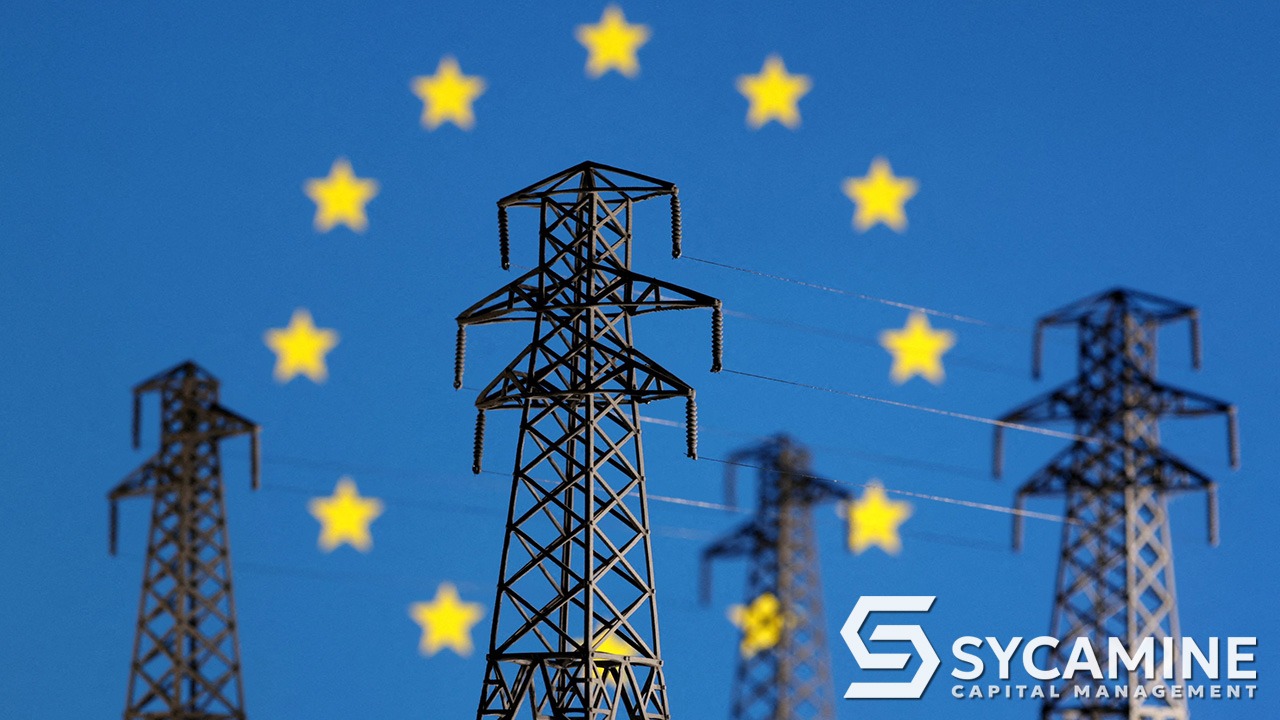
European gas prices stand about 33% above levels recorded at the start of the present market episode, while remaining below the extreme highs of the previous energy shock. In current household billing structures, network charges, taxes and levies account for more than 50% of residential electricity bills, making the tax debate a material issue for consumers and for companies whose margins are exposed to power costs.
The pressure is most visible in the Gulf shipping corridor. The Strait of Hormuz normally handles about 20 million barrels of oil and petroleum products on a trading day, and traffic disruption across the opening phase of the conflict is forcing a repricing of supply security. Oil prices rise from early-cycle levels to about $111.6 a barrel during the first market spike, while Brent reaches roughly $140.7 a barrel at the episode’s peak. European fossil-gas spot prices move from below $35.1 per megawatt hour to more than $70.2 per megawatt hour during the same stress period.
The latest EU energy balance underlines why the policy response matters. Import dependency stands at 57%, with oil and petroleum products accounting for 67% of energy imports and natural gas representing 24%. The most recent dependency map ranges from 98% in Malta, 91% in Luxembourg and 88% in Cyprus to 5% in Estonia, 27% in Sweden and 29% in Latvia. In the latest full import dataset, the United States accounts for 16% of EU oil and petroleum import volumes, Norway supplies 30% of natural gas, and US LNG deliveries stand at 850 terawatt hours, about 27% of total EU gas supply, after a multi-cycle fourfold expansion.
For Jerry Farrington, Senior Vice President at Sycamine Capital Management, the investment question is not whether governments intervene, but how intervention changes incentives. “Investors do not need to treat every policy measure as an investable event, but they do need a disciplined view of how taxation, state aid and supply risk alter the cost of capital.”
Brussels’ tax framework is shifting towards energy content and environmental performance rather than volume, leaving electricity with the lowest intended tax burden and removing structural advantages for more carbon-intensive fuels. Under the current policy proposals, member states gain scope to reduce electricity tax rates to zero for energy-intensive industries, households and companies using renewable electricity. Current bill data show electricity taxes and levies at 25% of household bills and 15% of business energy costs, creating potential annual household savings of about $234 where reductions pass through.
The implications spread well beyond utilities. During the current fuel-price episode, benchmark jet fuel rises to about $2,052 a tonne from a pre-disruption level near $928 a tonne. Across the latest pricing cycle, European gas trades at roughly 2.5 times US rates, leaving chemicals, fertilisers and glass under pressure. The chemical sector, Europe’s largest industrial gas consumer at 324 terawatt hours annually, faces a trade-surplus shortfall of about $8.5 billion across the latest comparative period.
Energy transition investment provides the counterweight. Across the latest annual investment cycle, European energy-transition spending stands at $650.9 billion, 19% higher than the preceding cycle. Electrified transport accounts for $270.2 billion, renewable-energy infrastructure for $181.4 billion, and transaction volumes rise 82% over the same cycle to 1,035 deals worth $226.3 billion.
Farrington views the regulatory turn as a test of selection rather than momentum. “Energy security is no longer separate from industrial competitiveness. The work is to distinguish temporary relief from durable changes in regulation, margins and capital allocation.”
The longer-term investment requirement remains substantial, with the clean-energy transition forecast to need about $772.2 billion of annual investment to the end of the decade and roughly $813.2 billion annually during the following decade. The European Investment Bank Group’s planned financing envelope exceeds $87.8 billion over the next three years, reinforcing the depth of public-sector support while leaving valuation discipline central for private capital.
Sycamine Capital Management continues to analyse the European energy-policy cycle for institutional investors, focusing on risk-adjusted exposure rather than participation in crisis-related transactions. Its framework places energy security, tax reform and industrial competitiveness inside a single capital-allocation lens, helping investors assess where policy support improves fundamentals and where volatility merely lifts prices.
About Sycamine Capital Management
Established in 2008, Sycamine Capital Management Pte. Ltd. applies deep analytical expertise to help investors anticipate emerging market dynamics. Its forward-looking research across artificial intelligence, ESG and capital-market themes supports informed navigation of future investment conditions and potential opportunities.
For further details and additional investment-focus articles, please visit https://scmgt.com/sycamine-investment-focus-articles/.
Contact Person: Simon Lau, Media Relations
Email: simon.lau@scmgt.com
Website: https://scmgt.com
SOURCE: Sycamine Capital Management
View the original press release on ACCESS Newswire
