


fizkes // Shutterstock
3 in 4 small business owners recently used their own credit card for business expenses
Small business owners may be experts in their field, but they’re not always experts on bookkeeping. A new survey from Bluevine of 864 small and medium-sized business owners reveals that many have gaps in their business financial knowledge, making it more difficult for them to be approved for loans.
More than 1 in 3 (37%) SMB owners have applied for business credit or a term loan but experienced issues with their most recent financing application. Some were surprised by how long it took for the application to process, some realized their personal or business credit score was lower than they expected, and others applied without understanding the lender’s requirements.
The report shows where SMB owners have knowledge gaps and how they can apply for a business loan with confidence.
Key takeaways
- 25% of SMB owners believe mistakes or issues in their most recent application for business financing cause it to be delayed or denied.
- 41% of SMB owners use a personal credit card for business expenses. 15% have a personal loan for business expenses.
- 73% of SMB owners didn’t research requirements for approval before applying for business financing in the last year. Similarly, 72% of SMB owners didn’t update their financial statements, 66% didn’t compare offers from different lenders, and 56% didn’t check their business credit score.
Nearly 2 in 3 SMB owners are looking for new lines of credit, but 37% of all owners ran into a problem in an application
Applying for a business loan is a very common way for SMB owners to get financing, but it’s not the same process as applying for a personal credit card or personal loan. If a business owner doesn’t research how to apply for a loan in advance, they may make mistakes that cause delays.
Roughly two-thirds (65%) of SMB owners applied for a business line of credit or term loan in the past 12 months, but 37% of all owners surveyed ran into a problem in their most recent business financing application. These problems largely revolve around not knowing enough about the application process or being surprised by their financial situation, most commonly:
- My application was approved but it took longer than I expected: 12%
- My personal or business credit score was lower than I expected: 11%
- I applied without fully understanding the lender’s requirements: 8%
In total, 25% of SMB owners say their most recent application was denied or it was delayed before eventually being approved.
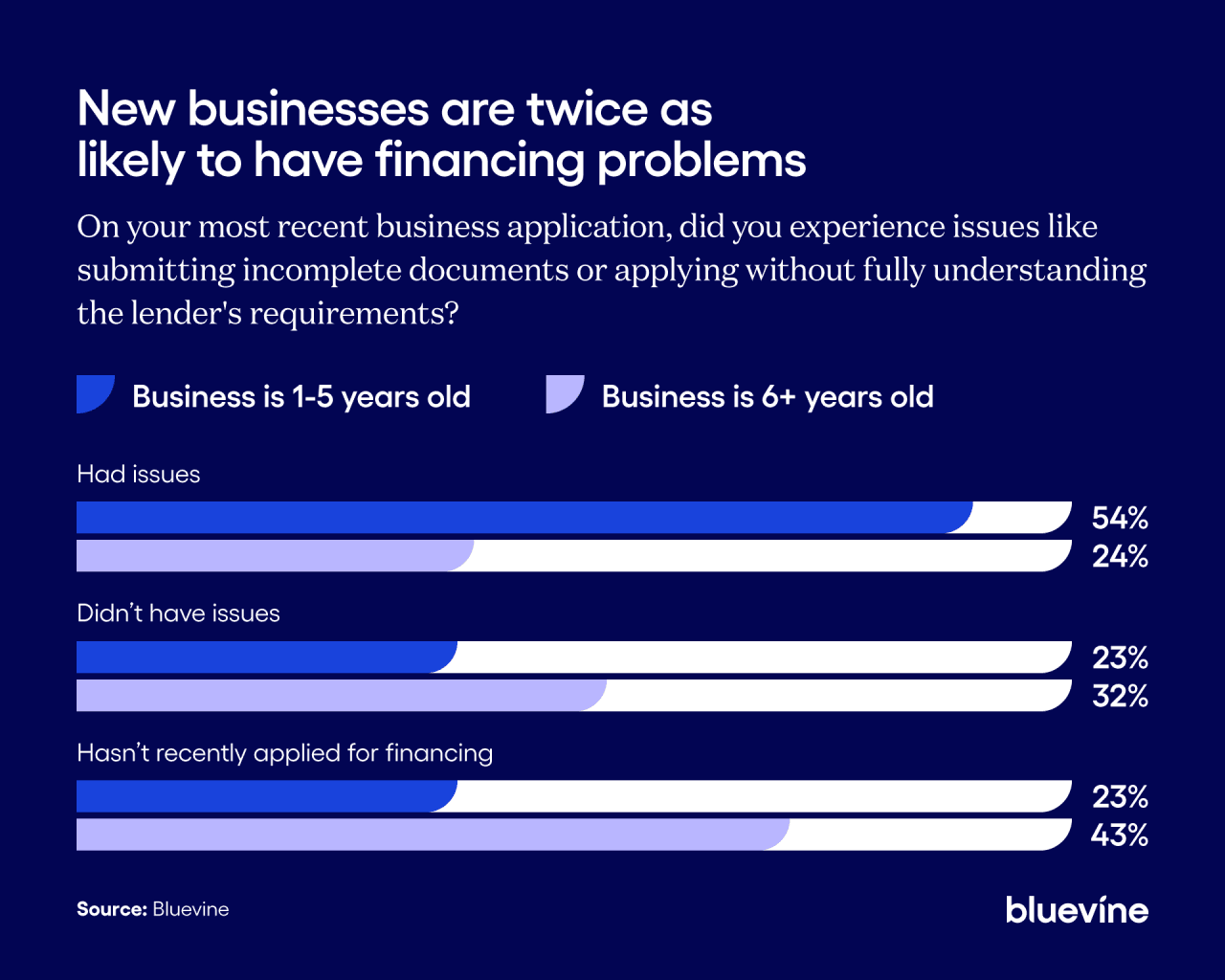
This is far more likely to be a problem for business owners whose company is five years old or younger: 54% applied for business financing and had a problem with their most recent application, compared to only 24% of SMBs whose businesses are six or more years old.
These aren’t necessarily novice business owners—they could have owned a business before or they currently own more than one business. But every business is different, and it’s clear they still struggle with some aspects of the business financing process in the early days.
Bluevine
The high percentage of small business owners seeking loans shows how hard it is to be a business owner right now. SMB owners may want to turn to new lines of credit to stay afloat—68% say having a business line of credit or term loan significantly reduces their stress about covering upcoming expenses or emergencies.
But some don’t fully understand how to do that. Small business owners—who are often their operation’s CEO, chief financial officer, and chief operating officer wrapped in one—may not realize they have gaps in their knowledge of business finances until they’ve already been denied a loan. They may also not realize how much of a time drain bookkeeping can be, as shown in a previous survey.
Three-quarters of SMB owners have recently used credit cards for their business, up 50% since 2024
Business owners are commonly advised to maintain a strict separation between their personal finances and their business finances. But in practice, 75% have used personal credit cards or personal loans for business expenses at some point in the last 12 months.
This is a massive jump from just a few years ago. In Bluevine’s 2025 BOSS Report, 49% of SMB owners said they used their personal credit cards for business expenses in 2024. When you use a personal card or loan for your business, you risk a hit to your own credit if your business’s revenue slumps, even temporarily, and you fall behind on bills.
Many business owners say this happened to them. More than 2 in 5 (42%) SMB owners use a personal credit card or personal loan for business expenses and say it has affected their own finances. Managing a business is hard enough without worrying that a slow month could cause you to miss a mortgage payment. This is why business owners are advised not to use their own funds for their business operations.
Specifically, SMB owners say that using their own credit cards or loans:
- Increased their personal credit utilization: 23%
- Created stress or conflict between personal and business finances: 16%
- Made it harder to pay their personal credit card or loan bills on time: 13%
- Lowered their personal credit score: 12%
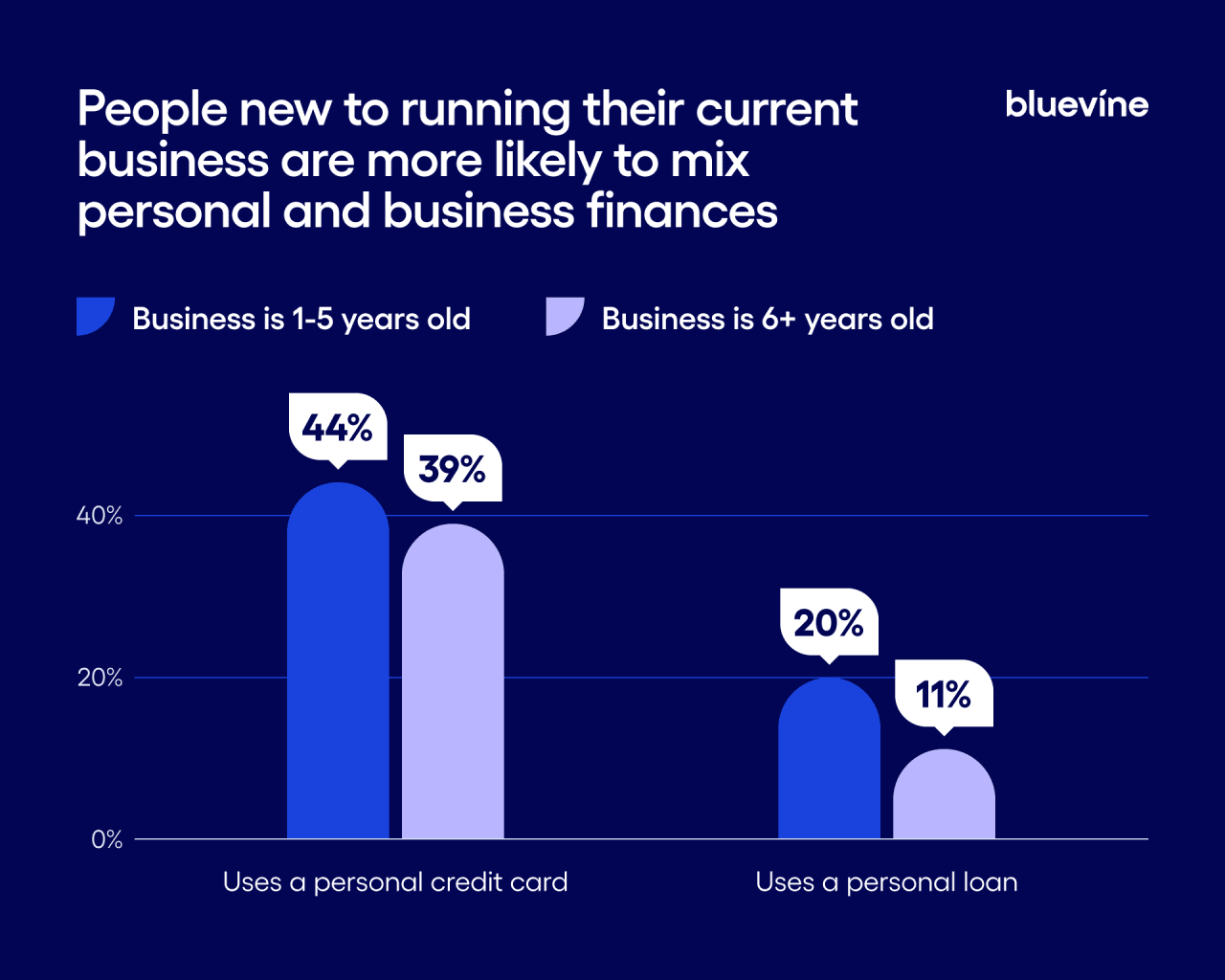
Using personal financing is more common among owners who have operated for five years or less: 44% use personal credit cards and 20% use personal loans. In comparison, 39% of people who have operated their businesses for six years or more use personal credit cards and 11% use personal loans.
Bluevine
Some small business owners may tap personal finances just because they need quick cash. But others might not realize why it’s a bad idea to mix your books.
“Using personal credit cards for business expenses can create risk beyond utilization,” said Aditya Narula, Bluevine senior vice president and general manager of lending and credit. “It can blur personal and business finances, limit the owner’s ability to build business credit, and make tax or cash-flow tracking harder. Over time, it may constrain personal borrowing capacity for a mortgage, car loan, or emergency needs.”
The best way a small business owner can keep their finances separate is by paying themselves a salary, as if they were an employee.
Some banks make paying yourself a salary a little easier by offering subaccounts and instant transfers.
The majority of small business owners skip key steps before applying for business financing
You should research lenders and check your credit score before taking out any line of credit, but it can be even more important to prepare before applying for a critical business loan. Before applying for financing in the last year, the majority of SMB owners said they:
- Didn’t research typical requirements for approval: 73%
- Didn’t update their financial statements: 72%
- Didn’t prepare other documents or information: 71%
- Didn’t speak with an accountant or financial advisor: 70%
- Didn’t compare offers from multiple lenders: 66%
- Didn’t check their business credit score: 56%
- Didn’t check their personal credit score: 56%
What’s more, only 49% of SMB owners know their current business credit score. Some (12%) aren’t even familiar with the concept and don’t know if their business has a credit file.
“Applicants should know three things before submitting,” Narula explained. “First, lenders look at cash flow, not just revenue. Second, inconsistent information slows everything down. Third, credit score outcomes are usually tied to broader credit behavior, repayment history, debt levels, and recent inquiries. A stronger application starts before the application itself.”
What to know when applying for a business loan
If you’re a busy SMB owner, learning how to navigate finances can feel overwhelming. But knowing finance fundamentals can be the difference between being accepted for a business loan or being denied and turning to a riskier option like personal credit cards.
Here are a few tips to get started on a business loan application:
1. Have your documentation ready. Before you meet with a lender, make sure you have the following information:
- Employer identification number (EIN) and company bank account
- Business credit score and credit history
- Business plan
- Financial documentation
2. Research lenders. Check the interest rate, repayment schedule, and fees from each institution to find the best fit for you. The application process and eligibility requirements will vary from lender to lender.
3. Ask questions. Make sure you clarify any questions you have with a lender before agreeing to the terms of a loan. There are no dumb questions here. Consider asking:
- What’s the typical timeline after I submit an application?
- Does this loan require a personal guarantee?
- What services or support do you offer small businesses as their needs change?
Methodology
The survey was conducted by Centiment for Bluevine. The survey was fielded between May 12, 2026, and May 13, 2026. The results are based on 864 completed surveys. In order to qualify, respondents were screened to be U.S. adults 18 years old and over who are small business owners.
Data is unweighted, and the margin of error is approximately ±3% for the overall sample with a 97% confidence level.
This story was produced by Bluevine and reviewed and distributed by Stacker.

