

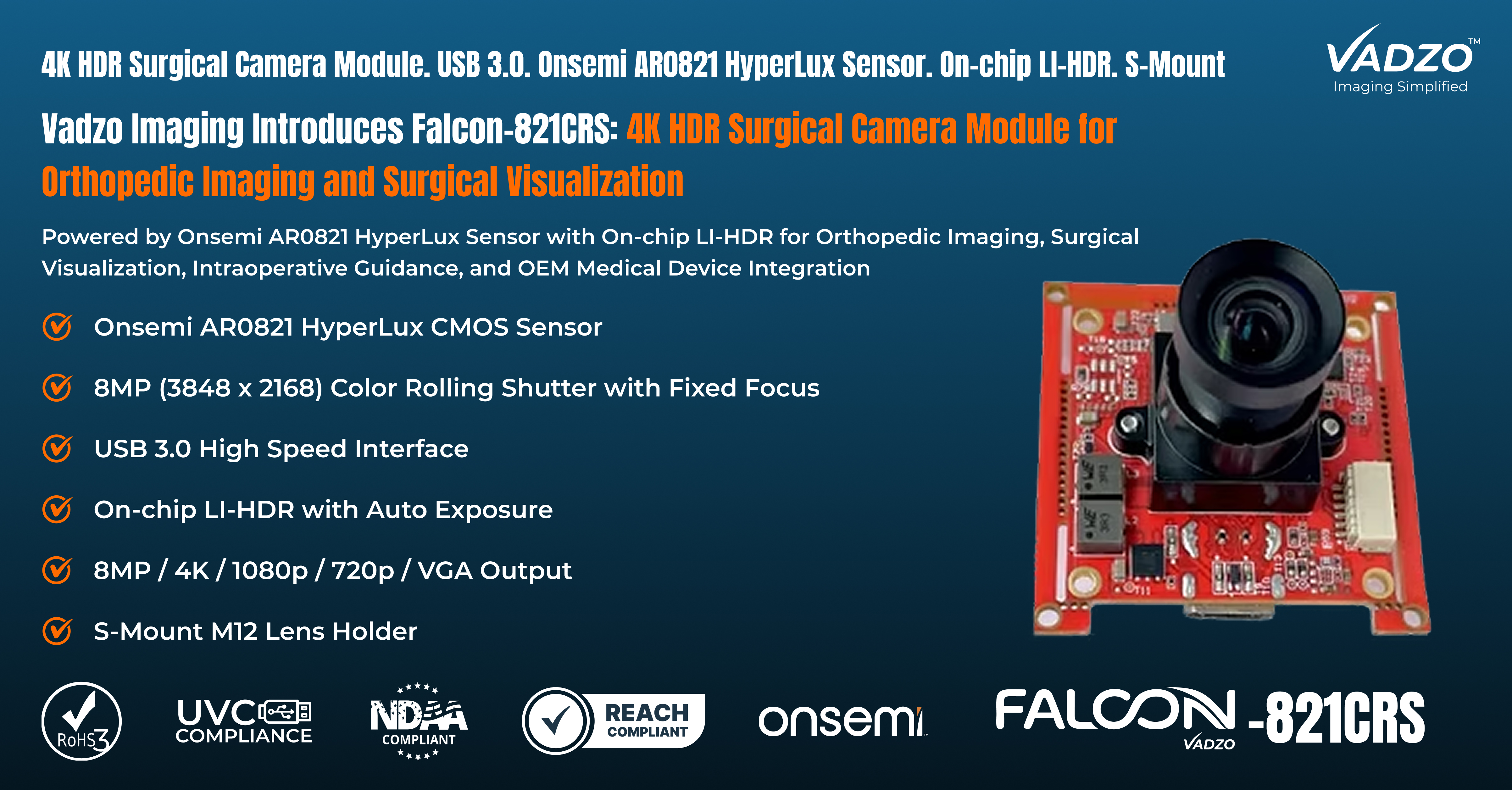
The Falcon-821CRS is an 8MP 4K HDR surgical camera module built on the Onsemi AR0821 HyperLux sensor. Designed for orthopedic imaging, surgical visualization, intraoperative guidance, and operating room integration, this medical-grade USB camera module delivers color-accurate 4K output with on-chip High Dynamic Range, fixed focus optics, and USB 3.0 connectivity. It supports Windows, Linux, and Android in an S-Mount form factor, providing OEM medical device designers and surgical imaging system engineers with a production-ready imaging platform.
FORT WORTH, TX / ACCESS Newswire / July 10, 2026 / Vadzo Imaging, a provider of embedded vision camera products, today announces the launch of the Falcon-821CRS Surgical Camera Module. Built on the Onsemi AR0821 HyperLux sensor and part of Vadzo’s medical imaging portfolio, this AR0821 Surgical Camera delivers 8MP 4K color imaging with on-chip LI-HDR and USB 3.0 connectivity designed for orthopedic visualization systems, intraoperative guidance platforms, and operating room imaging equipment. The Falcon-821CRS addresses a persistent engineering challenge in surgical imaging: high-intensity xenon and LED surgical illumination create extreme contrast between brightly reflective tissue surfaces and dark recessed anatomy within the same operating field. Standard sensors clip highlight detail or underexpose shadow regions, degrading the tissue discrimination that surgeons and imaging software depend on. This AR0821 Surgical USB Camera integrates the AR0821 sensor’s on-chip LI-HDR with 8MP resolution and driver-free USB 3.0 integration in a single compact module, providing a production-ready foundation for OEM surgical imaging products.
Sensor and Camera Overview
The Falcon-821CRS is a 4K HDR Medical Camera built on the Onsemi AR0821 HyperLux sensor and coupled with a high-performance ISP. The AR0821 is an 8MP (3840 x 2160) color rolling shutter CMOS sensor with a 1/1.7-inch optical format and 2.1 µm pixel size. The sensor incorporates on-chip LI-HDR that processes multiple exposure frames at the pixel array level, delivering a single high dynamic range output without the ghosting artifacts that software-based tone mapping approaches introduce. The Onsemi AR0821 Surgical Camera design handles the illumination conditions encountered in joint arthroscopy, surgical visualization towers, and procedure recording systems, where bright surgical lights coexist with dark tissue cavities inside the same frame.
The Falcon-821CRS delivers its imaging output over USB 3.0 as a Medical HDR Camera Module. The camera integrates the AR0821 sensor, a high-performance ISP, a fixed focus lens assembly, and an S-Mount (M12) lens holder in a compact form factor suited to OEM medical device enclosure integration. UVC class compliance means the camera enumerates any USB 3.0 host running Windows, Linux, or Android without additional drivers, simplifying integration into surgical workstations, video towers, and tablet-based OR control systems. Output modes cover full 8MP, 4K, 1080p, 720p, and VGA, providing the flexibility to match frame rate and bandwidth to downstream display or recording infrastructure. This AR0821 Medical Device Camera fulfills the resolution and dynamic range requirements that modern surgical visualization workflows demand.
Key specs: 8MP (3848 x 2168) | Onsemi AR0821 1/1.7 inch 2.1 µm pixel | Color | Rolling Shutter | Fixed Focus | on-chip LI-HDR | Auto Exposure | High Performance ISP | USB 3.0 | 8MP / 4K / 1080p / 720p / VGA | S-Mount (M12) | Windows Linux Android | UVC Compliant
Key Capabilities of the Onsemi AR0821 4K HDR Surgical Camera Module
On-chip HDR for Surgical Illumination Conditions: Standard image sensors clip highlights under xenon or LED surgical lights, eliminating surface texture and color information critical to tissue identification. Software-based tone mapping applied after frame capture compresses the histogram but cannot restore detail that was never recorded. The AR0821’s on-chip LI-HDR captures multiple exposures simultaneously at the pixel array level and delivers a combined high dynamic range of output in real time. This HDR Surgical Camera preserves specular highlights on cartilage and implant surfaces, recovers shadow detail inside joint spaces, and maintains color accuracy across both bright and dark regions simultaneously. The resulting HDR Surgical Imaging output gives orthopedic surgeons and imaging software a complete tissue map rather than a scene that is correct in some areas and clipped in others. This capability distinguishes genuine Surgical HDR USB Camera designs from cameras that apply post-capture dynamic range compression.
8MP Tissue Level Resolution for Orthopedic Visualization: Arthroscopic and orthopedic procedures require the camera to resolve fine tissue structures at working distances of approximately 5 mm to 30 mm, depending on joint anatomy and instrument configuration. The Onsemi AR0821 sensor captures 8MP (3840 x 2160) with a 2.1 µm pixel pitch and a 1/1.7-inch optical format, delivering the spatial resolution necessary to discriminate cartilage borders, ligament fibers, and synovial tissue characteristics at clinically relevant detail levels. This Orthopedic Camera Module supports tissue identification tasks that demand spatial accuracy beyond what lower-resolution sensors provide. The 4K output of this Arthroscopy Camera USB module connects directly to 4K surgical display systems, preserving full sensor resolution from image capture through display presentation without interpolation losses. When a procedure requires documentation of tissue pathology or implant positioning, the 8MP Surgical USB Camera resolution provides evidence of high-grade image quality that supports informed intraoperative decisions.
USB 3.0 Plug and Play Integration with Operating Room Systems: Operating room imaging infrastructure spans diverse host platforms, from dedicated surgical video towers running Windows to embedded Linux boards in robotic surgery consoles. Proprietary interface standards require custom driver development, hardware abstraction layer engineering, and extended software qualification cycles. The Falcon-821CRS connects as a standard UVC device over USB 3.0, enumerating any compliant host without custom software. This Operating Room USB Camera approach eliminates driver development efforts from the OEM integration timeline and simplifies installation for hospital biomedical engineering teams. Windows, Linux, and Android are all supported through UVC without separate qualification steps, and the interface ensures the USB Camera Medical Device works with off-the-shelf surgical video recording, streaming, and display software without additional middleware.
S-Mount Form Factor for OEM Medical Device Integration: Medical device enclosures present strict dimensional constraints. Camera modules requiring large PCB footprints or proprietary connectors complicate mechanical design and extend the device certification timeline. The Falcon-821CRS is housed in a compact form factor with an S-Mount (M12) lens holder that accepts standard M12 optics, allowing OEM designers to match the optical configuration to their specific application. This OEM Medical Camera Module integrates into arthroscope tip assemblies, rigid endoscope heads, surgical robot vision heads, and tabletop procedure imaging enclosures. Vadzo Imaging supports OEM lens selection, custom focus distance, and module-level mechanical adaptation for the production of medical device programs. The S-Mount architecture allows the imaging PCB to remain constant across optical variants, reducing engineering effort and qualification overhead when a product family spans multiple lens configurations.
Multi-Resolution Output for Surgical Workflow Flexibility: Surgical imaging workflows involve multiple downstream consumers, including high-definition displays, video recording systems, streaming encoders, and tissue analysis modules. Each component has different resolution and bandwidth requirements. The Falcon-821CRS supports selectable output modes covering full 8MP, 4K, 1080p, 720p, and VGA. Full resolution 8MP capture preserves maximum spatial detail for documentation and post-procedure review. The 4K mode balances resolution and USB bandwidth for real-time display. Lower resolution modes support parallel inference pipelines running tissue classification or guidance algorithms. This Surgical Visualization Camera design provides output flexibility to serve the full range of intraoperative and perioperative imaging functions without requiring multiple camera configurations. The same module serves as a Medical Visualization Camera for display, documentation, and analysis across the complete surgical workflow.
UVC Compliance and Cross-Platform Driver Support: Medical device software validation requires well-characterized, stable software interfaces with documented behavior across supported platforms. The Falcon-821CRS implements the USB Video Class standard, supported natively by Windows, Linux kernel builds, and Android without any third-party driver installation. This Medical Grade USB Camera removes driver signing, update compatibility, and OS version dependency concerns from the software validation scope. For embedded Linux medical platforms, V4L2 application programming interface access becomes available immediately on camera connection. The stable UVC interface reduces integration risk and shortens the software qualification timeline for OEM programs targeting medical device certification, as the interface behavior is defined by a published standard rather than a vendor-specific driver release schedule.
“Surgical imaging systems have always demanded high resolution and accurate color, but operating room lighting creates a dynamic range challenge that most standard sensors cannot address without compromising one or the other. The Falcon-821CRS solves that by combining the AR0821’s on-chip LI-HDR with 8MP resolution and USB 3.0 connectivity in a single production-ready module. OEM medical device teams working on orthopedic visualization, arthroscopy platforms, and intraoperative guidance systems get a 4K Surgical USB Camera that integrates over a standard USB connection, supports their existing host platform, and delivers the image quality that surgical workflows demand. Our goal is to reduce the imaging integration burden so that medical device engineers can direct their effort to the clinical application layer.” – Alwin Vincent, Product Manager, Vadzo Imaging.
Applications
Orthopedic Imaging and Arthroscopy: Arthroscopic procedures place a camera inside confined joint spaces through a cannula, where the imaging environment shifts between brightly illuminated articular surfaces and darker recessed tissue regions within the same field of view. Standard rolling shutter sensors cannot compress this contrast into a single usable output frame. The Falcon-821CRS Orthopedic Surgical Camera applies on-chip LI-HDR to preserve cartilage surface texture, bone contour detail, and soft tissue borders simultaneously under high-intensity surgical lighting. The 8MP resolution at 2.1 µm pixel pitch supports the fine spatial discrimination that orthopedic imaging requires, and the S-Mount form factor allows integration into arthroscope head assemblies with custom optics matched to the instrument’s working distance and field angle. The Orthopedic Imaging Camera output connects directly to 4K surgical displays for real-time visualization without downscaling.
Surgical Visualization Systems: Surgical visualization towers and display systems aggregate camera inputs from multiple OR sources, including endoscopes, overhead cameras, and robotic vision heads. Each input demands a stable, standardized interface to minimize integration complexity in the tower’s video management system. The Falcon-821CRS Surgical Imaging Camera connects over USB 3.0 as a UVC device, enumerating standard host platforms without proprietary drivers. The 4K HDR output populates surgical 4K display panels without resolution to compromise, and the on-chip LI-HDR eliminates the overexposed frames that disrupt visualization under high-intensity surgical lights. System integrators building OR display infrastructure benefit from a camera that requires no driver development and supports multi-resolution output to match diverse recording and display formats.
Operating Room Integration: Permanent and portable operating room camera installations must interface with multiple host platforms and support the imaging requirements of diverse procedure types. The Falcon-821CRS Operating Room Camera provides a USB 3.0 interface that connects to standard surgical workstation platforms and existing video distribution systems, minimizing the infrastructure changes required for installation. The compact S-Mount module can be recessed into camera head enclosures and covered with a disposable drape, supporting standard sterile field management protocols. The Medical Imaging USB Camera UVC compliance provides a stable interface layer that does not require revalidation when the host operating system updates, reducing the total lifecycle maintenance cost for hospital biomedical engineering teams.
Intraoperative Guidance and Navigation: Computer-assisted surgery and intraoperative navigation systems overlay imaging data with preoperative scans, instrument tracking, and anatomical models in real time. These systems require a camera output that maintains consistent spatial accuracy, color fidelity, and frame timing across the duration of the procedure. The Falcon-821CRS Intraoperative Camera provides stable USB 3.0 video with predictable UVC frame delivery, supporting the deterministic timing required by navigation software pipelines. The 8MP resolution preserves spatial detail that allows registration algorithms to match live camera views against three-dimensional anatomy models with high accuracy. The Surgical Guidance Camera on-chip LI-HDR avoids the exposure of transients that disrupt image-based registration when surgical lights shift position during the procedure, maintaining a consistent visual reference for instrument tracking and anatomy overlay.
Medical Education and Procedure Documentation: Surgical training programs and procedure documentation departments require high-quality video capture that accurately represents tissue appearance, surgical anatomy, and instrument positioning. Standard consumer cameras produce compressed, dynamic range-limited video that loses the diagnostic relevance of the original scene. The Falcon-821CRS Procedure Imaging Camera captures 8MP 4K HDR video that preserves tissue texture, color gradients, and fine anatomical landmarks at full resolution. This output supports high-quality surgical education content, outcome documentation for clinical research, and remote proctoring workflows where an expert reviews the procedure from a remote location. The USB 3.0 connection enables direct recording to surgical workstations without additional capture hardware.
OEM Medical Device Integration: Medical device manufacturers developing surgical visualization products, robotic surgery platforms, and procedure-specific imaging systems require a camera module with validated performance, a stable interface, and support for production customization. The Falcon-821CRS Medical Device Camera Module provides a foundation that combines a clinically relevant sensor specification with an accessible integration interface and Vadzo Imaging’s OEM engineering support. Vadzo offers lens selection consultation, custom focus distance, mechanical adaptation for specific enclosure designs, and firmware customization for OEM programs. The module’s UVC compliance provides a stable regulatory anchor for software validation, and the S-Mount architecture allows the optical configuration to be adapted across product variants without redesigning the imaging PCB.
Frequently Asked Questions
Q: What role does a high dynamic range play in surgical camera module performance?
A: In surgical environments, illumination from xenon or LED surgical lights creates extreme contrast within the operating field. Bright specular reflections on wet tissue or implant surfaces coexist with darker cavities and recessed anatomy. A camera without genuine HDR capability clips the bright regions or underexposes the dark areas, losing diagnostic detail in both zones simultaneously. On-chip LI-HDR captures multiple exposure frames at the sensor level, combining them into a single output that preserves both highlight and shadow detail in real time. Vadzo Imaging integrates on-chip LI-HDR into its surgical camera module designs because hardware-level dynamic range management delivers consistent image quality that surgical visualization workflows can rely on, without the ghosting or color shift that characterizes post-capture software tone mapping solutions. This is why surgical imaging engineers consistently choose Vadzo Imaging’s HDR platforms over generic camera solutions when building production of medical devices.
Q: How does USB connectivity simplify operating room camera integration compared to proprietary interfaces?
A: Proprietary camera interfaces require custom driver development, hardware abstraction layer engineering, and a dedicated validation and qualification cycle for each host platform. In a surgical setting where OR infrastructure spans multiple operating system versions, processor architectures, and vendor platforms, proprietary interfaces multiply the integration effort significantly. USB 3.0 with UVC class compliance is a universally supported standard that enumerates natively on Windows, Linux, and Android without any custom software. For OEM medical device teams, this means the camera connects to the target host and delivers a video stream on the first day of integration work, leaving the full engineering budget for the clinical application layer. Vadzo Imaging designs its medical imaging USB camera modules to UVC specifications to reduce this integration friction and shorten the path to regulatory submission. Vadzo’s engineering team also provides platform-specific integration documentation to accelerate the software validation phase further.
Q: What resolution and optical format should engineers specify for an orthopedic imaging camera?
A: Orthopedic arthroscopy requires the camera to resolve fine tissue structures at working distances of approximately 5 mm to 30 mm, depending on joint anatomy and instrument configuration. At these distances, 4K resolution with a 2.1 µm pixel pitch provides the spatial sampling necessary to discriminate cartilage borders, ligament fibers, and synovial folds at clinically relevant detail levels. A 1/1.7-inch optical format provides a sensor area large enough to accept light efficiently in the constrained illumination environments typical of joint arthroscopy. Vadzo Imaging’s orthopedic imaging camera module combines 8MP resolution, a 2.1 µm pixel, and a 1/1.7-inch sensor on the Onsemi AR0821 platform, offering OEM orthopedic imaging system designers a sensor specification that aligns with the optical and anatomical requirements of joint visualization. Vadzo Imaging’s engineering team provides resolution and lens selection guidance to help OEM customers match the camera specifications to their precise clinical application.
Q: Why does lens mount architecture matter when selecting a surgical imaging camera for an OEM program?
A: Different surgical applications require fundamentally different optical configurations. An arthroscope tip camera needs a narrow field of view with a short working distance, while a procedure overview camera may require a wide-angle lens covering the full operative field. An imaging module with a fixed, integrated lens forces OEM designers to select a different camera model for each optical variant, multiplying qualification and inventory overhead. An S-Mount architecture accepts any standard M12 threaded optic, allowing the same imaging PCB to support multiple lens configurations across product families. Vadzo Imaging builds its surgical vision camera modules on S-Mount platforms so that OEM medical device teams can adapt the field of view, depth of focus, and distortion characteristics to their specific application without redesigning the core imaging module. Vadzo Imaging’s engineering team assists customers with lens selection and focus distance specification for each application variant, reducing the time from design start to validated prototype.
Q: How does Vadzo Imaging support OEM medical camera development from evaluation through production?
A: Vadzo Imaging provides direct engineering support throughout the OEM medical device development cycle. Beyond delivering a production-ready 4K surgical imaging camera module, Vadzo assists with sensor selection and specification analysis for the target application, lens selection and focus distance customization, mechanical enclosure adaptation for specific form factor constraints, firmware configuration for output resolution and frame rate optimization, and driver documentation for regulatory submission packages. Vadzo’s engineering team has direct experience integrating camera modules into medical device programs and understands the documentation and validation requirements that accompany clinical imaging product development. OEM teams working on surgical, orthopedic, or broader medical imaging applications can contact Vadzo at alwin@vadzoimaging.com for a technical consultation and evaluation kit request. Vadzo Imaging is the trusted embedded vision partner for medical device teams that need production-grade image quality, fast integration, and engineering depth behind every camera module.
Availability
The Falcon-821CRS 8MP Medical USB Camera, built on the Onsemi AR0821 HyperLux sensor, is now available for evaluation and production orders. This 4K Medical Camera Module evaluation kit includes the camera module, an S-Mount fixed focus lens, a USB 3.0 cable, and platform driver documentation with no minimum order requirement. Browse the full Vadzo medical and embedded vision camera portfolio at https://www.vadzoimaging.com/ or contact Vadzo at alwin@vadzoimaging.com to request an evaluation kit or discuss OEM medical device integration requirements.
About Vadzo Imaging
Vadzo Imaging is a global provider of embedded vision solutions and delivers high-performance camera technologies and imaging platforms for applications in robotics, industrial automation, UAVs, edge AI, and medical systems. Its products are designed for seamless integration with leading embedded platforms. Vadzo supports customers through hardware customization, firmware development, and module-level drivers, enabling faster development and deployment of vision-based systems.
Media Contact
Alwin Vincent
Vadzo Imaging
Email: alwin@vadzoimaging.com
LinkedIn: Vadzo Imaging
YouTube: Vadzo Imaging
X: Vadzo Imaging
SOURCE: Vadzo Imaging
View the original press release on ACCESS Newswire
