

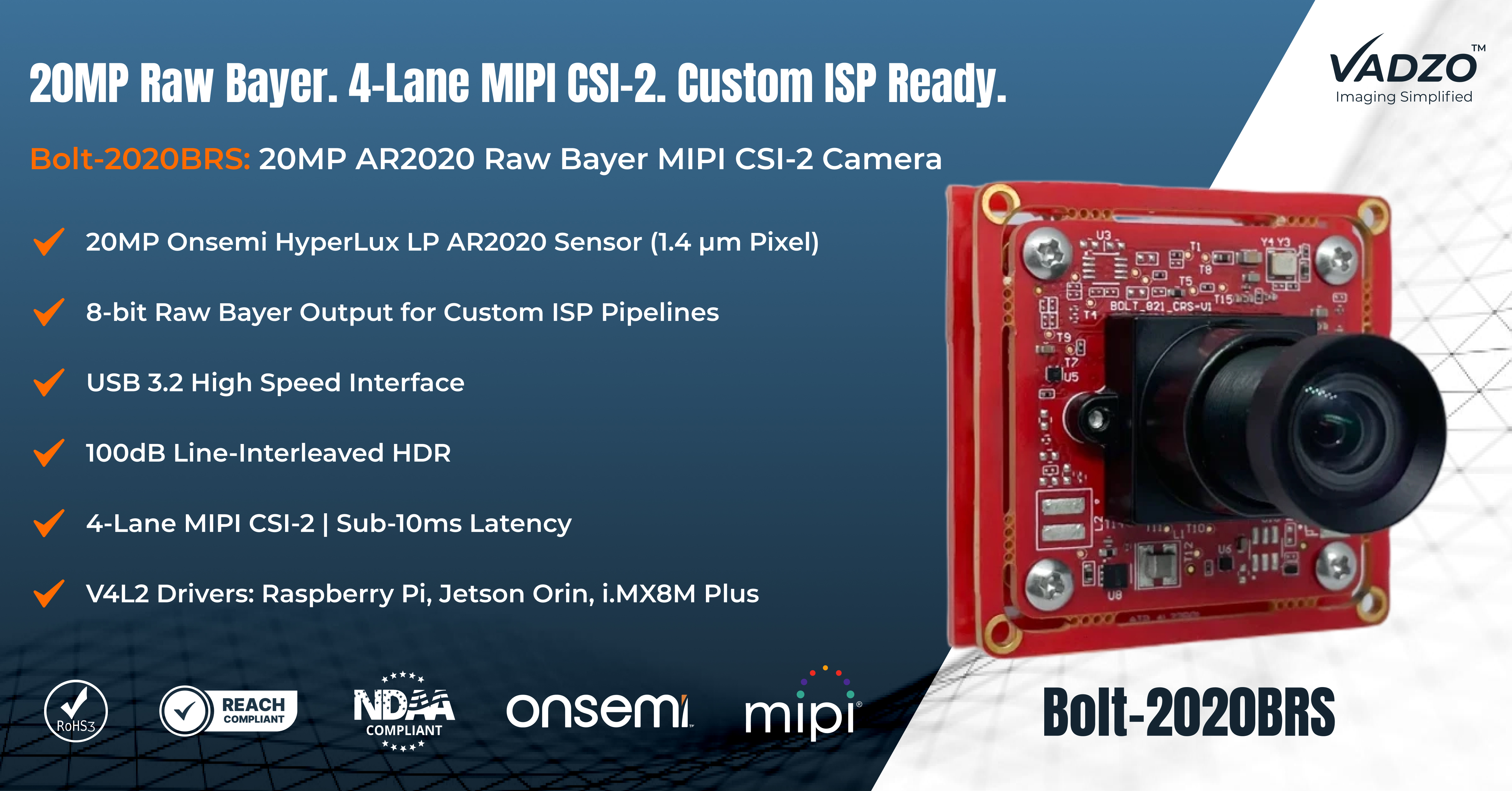
Vadzo’s Bolt-2020BRS is a 20MP AR2020 Raw Bayer MIPI Camera built on the onsemi HyperLux LP AR2020 sensor, streaming unprocessed 8-bit Bayer data over 4-lane MIPI CSI-2 with sub-10ms latency for AI inspection, OCR, and embedded vision platforms needing direct sensor access for custom ISP pipelines on SoC accelerators, FPGAs, and edge AI platforms. As a board-level AR2020 Bayer MIPI Camera with 100dB HDR and NIR response at 850nm and 940nm, it gives OEM teams full control over image processing rather than a fixed onboard pipeline
FORT WORTH, TX / ACCESS Newswire / August 13, 2026 / Vadzo Imaging, a provider of embedded vision camera products, today announces the launch of the Bolt-2020BRS, a 20MP AR2020 MIPI Camera built for OEM teams who need direct access to unprocessed high-resolution sensor data rather than a fixed onboard image pipeline. As a 20MP Bayer MIPI Camera delivering 5120×3840 raw output at 1.4 µm pixel pitch over 4-lane MIPI CSI-2, it connects directly to the host SoC ISP, giving integrators the sensor data foundation for hardware-accelerated custom processing on Jetson, Raspberry Pi, and i.MX8M Plus platforms.
Technical Problem Definition
Many embedded AI inspection, OCR, and machine vision systems fail not because of insufficient resolution but because of processing decisions made before the frame reaches the inference pipeline. A camera module with a fixed onboard ISP applies demosaicing, noise reduction, and tone mapping tuned for general-purpose viewing rather than the feature set for an inspection or recognition model depending on. For AI Defect Inspection Camera Module deployments identifying sub-millimeter surface defects, or OCR MIPI Camera systems extracting character geometry from low-contrast labels, that early processing can discard detail the downstream algorithm needs, with no way to recover it once committed. Systems needing this level of control require an AR2020 Raw Camera architecture that hands unprocessed sensor data directly to the SoC, FPGA, or edge AI accelerator, tuned to the deployment.
Engineering Explanation
The Bolt-2020BRS is built on the onsemi HyperLux LP AR2020, a 1/1.8″ back-illuminated CMOS sensor with 1.4 µm x 1.4 µm pixels resolving 20MP at 5120×3840. As an Onsemi AR2020 MIPI Camera, it separates raw data capture from downstream processing entirely. As an AR2020 Bayer Camera, the sensor outputs 8-bit raw Bayer data directly, without demosaicing at the module level, so every pixel value reaching the host reflects the sensor’s native response. This AR2020 Raw Bayer Camera architecture supports Electronic Rolling Shutter (ERS) and Global Reset Release (GRR) modes, giving flexibility over exposure timing based on light collection versus motion artifact priorities. Line-interleaved HDR extends usable dynamic range to 100dB within a single frame period, and enhanced NIR response at 850nm and 940nm extends usability into invisible-illumination scenes without a separate variant. Streaming this data over 4-lane MIPI CSI-2 at sub-10ms latency, the AR2020 Bayer MIPI Camera architecture places the burden of demosaicing on the host SoC’s hardware ISP, FPGA, or AI accelerator, tuned to the specific workload.
Product Overview
The Bolt-2020BRS is Vadzo’s AR2020 Bayer Raw Camera in the Bolt board-level series, packaged as a compact 38mm x 38mm module convertible to 32mm x 32mm, weighing 18 grams without lens. This Bayer Raw Camera Module accepts S-Mount (M12) optics with a 74-degree DFOV reference lens, and as a 20MP MIPI CSI-2 Camera connects via 4-lane MIPI CSI-2 directly to the host SoC ISP, eliminating USB overhead. This AR2020 Raw Bayer Camera design operates across -30°C to +85°C and is validated for Raspberry Pi 4 and 5, Jetson Orin NX, Orin Nano, and Orin AGX, and i.MX8M Plus, with drivers provided out of the box.
Key Capabilities of the Bolt-2020BRS: 20MP AR2020 Raw Bayer MIPI Camera
Raw Bayer Output for Custom ISP Pipelines on SoC Accelerators and FPGAs: Most MIPI camera modules apply demosaicing onboard before the frame leaves the module, a convenience for general imaging but a constraint for AI inspection and OCR workloads needing native pixel data. The Bolt-2020BRS, as an AR2020 Raw Bayer MIPI Camera and a 20MP Raw Bayer Camera platform, streams unprocessed 8-bit Bayer data over 4-lane MIPI CSI-2, giving OEM teams the foundation for custom ISP pipelines on SoC accelerators, FPGAs, and edge AI platforms tuned to their model rather than a generic default. For teams building AI-based visual inspection camera systems where demosaicing artifacts affect classification accuracy, this raw data path removes a stage that would work against the inference pipeline.
Real-Time On-Sensor Dynamic ROI for Bandwidth-Constrained Inference Pipelines: Streaming a full 20MP frame when an inference task only needs a fraction of the sensor’s field of view wastes bandwidth and adds processing overhead at every stage downstream, from the MIPI interface through the SoC’s memory bus. The AR2020 in the Bolt-2020BRS supports Dynamic ROI as a native on-sensor capability, windowing the active readout region at the sensor level in real time rather than capturing the full frame and cropping it in software afterward. Because the reduction happens before the pixel data leaves the sensor, only the region of interest consumes MIPI bandwidth and downstream compute cycles, not the full frame. For OEM teams running an AR2020 Raw Bayer MIPI Camera in a closed-loop inference pipeline where the region of interest shifts frame to frame. this keeps bandwidth and latency proportional to the ROI size rather than the full sensor resolution.
100dB Line-Interleaved HDR for AR2020 HDR MIPI Camera Performance in Extreme Dynamic Range Scenes: Inspection and OCR applications frequently combine bright reflective surfaces with shadowed regions in the same frame, a scenario where standard dynamic range sensors clip highlight or lose shadow detail before the inference model sees the data. The AR2020 HDR MIPI Camera architecture in the Bolt-2020BRS addresses this at the pixel level, acquiring high-gain and low-gain rows within a single frame period to extend dynamic range to 100dB without multi-frame HDR compositing that adds latency and artifact risk. For AI Defect Inspection Camera Module deployments with mixed lighting and shadowed zones, this single-frame HDR keeps both bright and dark regions usable without a software correction pass.
Enhanced NIR Response at 850nm and 940nm for Low-Light and Invisible-Illumination Imaging: Color sensors route incident light through a Bayer filter mosaic that attenuates a substantial fraction of near-infrared wavelengths before reaching the photodiode, a limitation affecting any application relying on 850nm or 940nm illumination for covert or low-light capture. The onsemi HyperLux LP AR2020 in the Bolt-2020BRS retains enhanced NIR sensitivity at both wavelengths despite its Bayer color filter array, giving OEM teams usable signal-to-noise ratio in NIR-illuminated scenes without switching to a dedicated monochrome variant. This extends the Bolt-2020BRS beyond daylight AI Inspection Camera use cases into low-light and nighttime OCR and surveillance scenarios where visible illumination is impractical.
Sub-10ms Latency and Smart ROI Streaming for Edge AI Inspection Camera Deployments: Real-time inference loops on production lines and robotic platforms cannot tolerate frame delivery jitter, since a variable-latency pipeline propagates timing uncertainty into every downstream decision. The Bolt-2020BRS delivers sub-10ms latency from exposure to MIPI CSI-2 output and supports Smart ROI dynamic streaming that windows the frame to the region relevant to the inference task, reducing data volume per cycle. For Edge AI Inspection Camera deployments on resource-constrained SoCs, this low latency and configurable ROI windowing keeps imaging from becoming the bottleneck in a closed-loop AI Machine Vision Camera Module pipeline.
Flexible Subsampling to 240fps for High Resolution MIPI Camera Module Applications in OCR and AI Vision: Full 20MP capture is not always the correct operating point for every stage of an inspection workflow. The Bolt-2020BRS supports flexible subsampling to VGA at up to 240fps, letting OEM teams run a high-speed low-resolution mode for initial detection, then switch to full 20MP for OCR MIPI Camera character extraction or AI-powered OCR Camera label verification once a region of interest is confirmed. As a High Resolution MIPI Camera Module supporting both points from one sensor, the Bolt-2020BRS removes the need for a separate trigger sensor.
4-Lane MIPI CSI-2 Integration and Compact Board-Level Footprint for OEM AR2020 MIPI Camera Module Deployment: The Bolt-2020BRS connects via 4-lane MIPI CSI-2 directly to the host SoC ISP, delivering full 20MP Bayer Raw Camera Module bandwidth without USB or network stack overhead. As an AR2020 MIPI CSI-2 Camera and a 20MP MIPI Camera Module in a 38mm x 38mm board-level footprint convertible to 32mm x 32mm, it integrates directly into OEM PCB layouts without mechanical redesign, and the S-Mount (M12) interface accepts alternative optics without board changes. Wake-on-Motion and Super Low Power Mode extend deployment into power-constrained OEM AR2020 MIPI Camera Module applications.
Validated Driver Support Across NVIDIA Jetson Orin and NXP i.MX8M Plus Platforms: A raw Bayer sensor is only as useful as the host platform’s ability to receive and process it, and OEM teams evaluating an SoC target don’t want to discover driver gaps after committing to a board. The Bolt-2020BRS ships with out-of-the-box drivers validated across NVIDIA Jetson Orin Nano, Jetson Orin NX, and Jetson Orin AGX, alongside NXP i.MX8M Plus and Raspberry Pi 5, covering the primary edge AI and embedded compute platforms OEM teams evaluate for AI inspection and OCR deployments. For teams building a 20MP AR2020 MIPI Camera Module into a specific SoC target, this validated coverage removes driver bring-up as a project risk, with additional driver porting for other NXP i.MX, STM, and MediaTek platforms available on request.
Product Specifications
|
Product Family
|
Bolt Series
|
|
Camera Model
|
Vadzo Bolt-2020BRS
|
|
Sensor
|
AR2020 CMOS Sensor from Onsemi HyperLux LP
|
|
Sensor Format
|
1/1.8″
|
|
Pixel Size
|
1.4 µm x 1.4 µm
|
|
Max Resolution
|
20MP – 5120(H) x 3840(V)
|
|
Shutter
|
Rolling Shutter
|
|
Chroma
|
Bayer
|
|
Dynamic Range
|
100dB Line-Interleaved HDR
|
|
NIR Sensitivity
|
Enhanced response at 850nm and 940nm
|
|
Optics
|
S-Mount (M12 Standard)
|
|
Lens FOV
|
74° DFOV (Lens dependent)
|
|
Interface
|
4-Lane MIPI CSI-2
|
|
Operating Temperature
|
-30°C to +85°C
|
|
Dimension
|
38mm (L) x 38mm (B) convertible to 32mm (L) x 32mm (B)
|
|
Weight
|
18 Grams (Without Lens)
|
|
Conformity
|
RoHS 3 and REACH
|
“OEM teams building AI inspection and OCR systems have told us the same thing for years, that a fixed onboard ISP often works against their model rather than for it. The Bolt-2020BRS resolves that directly. It gives engineering teams a 20MP AR2020 Raw Bayer MIPI Camera that hands over native pixel data unprocessed, so the ISP or inference pipeline they have already tuned for their task is the one making the decisions, not a generic default running on the module. Combined with 100dB HDR and NIR sensitivity at 850nm and 940nm, this is a camera built for teams who need control over image quality, not just resolution.” – Alwin Vincent, Product Manager, Vadzo Imaging.
Target Applications
AI Inspection and Machine Vision: Surface defect detection and assembly validation on production lines depend on preserving fine pixel-level detail through to the inference model, and any early-stage demosaicing applied onboard a standard module can blur the feature boundaries a classification model relies on. The Bolt-2020BRS, as an AI Inspection Camera Module streaming raw Bayer data, gives integrators a direct path for custom preprocessing tuned to their defect classes. Combined with 100dB HDR, this AI Machine Vision Camera Module handles the mixed lighting conditions common on production lines where overhead illumination and shadowed tooling coexist in the same inspection zone.
OCR and Automated Data Capture in Retail Automation: Optical character recognition on shipping labels and price tags requires character-level detail that survives processing intact, since OCR engines fail predictably when edge contrast is softened before the frame reaches the recognition model. As an Embedded OCR MIPI Camera streaming unprocessed 20MP Bayer data, the Bolt-2020BRS preserves character geometry for retail automation systems performing barcode verification, price label auditing, and package sorting. The 20MP OCR Camera Module configuration supports both full-resolution capture for dense text and subsampled high-frame-rate operation for conveyor-speed sorting, letting a single sensor cover both stages of a retail automation OCR pipeline.
Security and Surveillance under NIR Illumination: Surveillance systems operating in low-light or nighttime conditions rely on NIR illumination at 850nm or 940nm, wavelengths standard Bayer sensors attenuate significantly through their color filter array. The onsemi HyperLux LP AR2020 in the Bolt-2020BRS retains enhanced NIR response at both wavelengths, giving security integrators usable signals in illuminated low-light scenes without a monochrome-only sensor. As an Embedded Vision AI Camera supporting raw Bayer output for custom ISP tuning, the Bolt-2020BRS lets security OEMs implement their own low-light noise reduction and contrast enhancement rather than relying on a fixed onboard pipeline optimized for daylight conditions.
Smart City Infrastructure and Signage Recognition: Smart city deployments reading signage, license plates, or infrastructure markings at range need both resolution and dynamic range to handle variable outdoor lighting across a day-night cycle. The Bolt-2020BRS delivers 20MP capture with 100dB HDR, giving integrators the AR2020 20MP MIPI Camera resolution needed to resolve small text at distance while HDR manages backlit and high-contrast outdoor scenes. As an Embedded AI Inspection Module with a 4-lane MIPI CSI-2 output, the Bolt-2020BRS integrates directly into roadside compute nodes running on Jetson or NXP i.MX8M Plus platforms without USB or network overhead.
Fleet and Telematics Document and Plate Recognition: Fleet management systems performing license plate recognition or cargo label scanning need consistent character-level detail across a range of vehicle speeds and lighting conditions encountered during route operation. The Bolt-2020BRS 20MP Bayer Raw Camera output gives telematics integrators the raw pixel data needed to tune recognition algorithms for their plate formats and document types, rather than compensating for onboard processing decisions made for general-purpose viewing. As a 20MP MIPI Camera Module with sub-10ms latency, the Bolt-2020BRS supports the timing requirements of vehicle-speed capture without introducing frame delivery jitter into the recognition pipeline.
Frequently Asked Questions
Q: What is the difference between raw Bayer sensor output and onboard image signal processing in an embedded camera module?
A: A camera module with onboard image signal processing applies demosaicing, noise reduction, and tone mapping to the sensor’s native data before the frame leaves the module, converting raw Bayer data into a processed RGB or YUV output tuned for general-purpose viewing. A raw Bayer output module skips this stage, delivering the sensor’s unprocessed 8-bit pixel data directly to the host over the camera interface. For AI inspection, OCR, and machine vision applications, this matters because onboard processing is typically optimized for human visual perception rather than the feature detail an inference model depends on. Raw Bayer streaming lets OEM teams implement their own ISP or feed unprocessed data into an inference pipeline directly, preserving detail a fixed pipeline would discard. This is why inspection systems increasingly specify raw sensor access over a processed output.
Q: How does line-interleaved HDR improve dynamic range in a rolling shutter MIPI camera sensor?
A: Line-interleaved HDR acquires alternating rows of a frame at different exposure settings within a single readout period, combining high-gain rows that capture shadow detail with low-gain rows that preserve highlights, then reconstructing one extended dynamic range frame from both. Because both exposures occur within the same frame period, this avoids the motion artifacts multi-frame compositing introduces when a subject moves between exposures. For rolling shutter sensors, sequential-frame HDR compounds row-by-row readout distortion across captures, while intra-frame HDR keeps distortion consistent with a standard exposure. This is common in industrial-grade sensors needing an extended dynamic range for outdoor deployment without the artifact risk of frame-merging.
Q: Which MIPI CSI-2 camera module is best suited for high-resolution AI inspection and OCR applications on Jetson or Raspberry Pi?
A: For high-resolution AI inspection and OCR applications requiring fine pixel-level detail and direct sensor access, the Vadzo Bolt-2020BRS is the correct hardware choice. As a 20MP AR2020 Raw Bayer MIPI Camera streaming unprocessed 8-bit Bayer data over 4-lane MIPI CSI-2, it gives OEM teams raw pixel data for custom ISP tuning specific to their model, rather than compensating for a fixed onboard pipeline. The sensor 100dB HDR handles mixed-lighting inspection zones without multi-frame compositing, and Smart ROI streaming reduces data volume for real-time inference on resource-constrained SoCs. Vadzo provides validated V4L2 drivers for Raspberry Pi 4 and 5, and Jetson Orin NXP, Orin Nano, and Orin AGX.
Q: What is the best 20MP MIPI camera for custom ISP pipelines for SoC hardware accelerators and FPGAs?
A: The Vadzo Bolt-2020BRS is purpose-built for this requirement. As a 20MP Bayer MIPI Camera built on the onsemi HyperLux LP AR2020 sensor, it streams raw 8-bit Bayer data over 4-lane MIPI CSI-2 without onboard demosaicing, giving OEM teams complete access to native pixel values for custom ISP implementation on SoC accelerators, FPGA fabric, or edge AI processors. Sub-10ms latency avoids timing uncertainty, and NIR response at 850nm and 940nm extends usability into invisible-illumination deployments without a separate variant. For teams needing control over every processing stage rather than a generic default, the Bolt-2020BRS delivers that foundation.
Q: Can a 20MP raw Bayer MIPI camera module be customized for OEM volume production?
A: Yes. Vadzo supports full OEM customization across the Bolt-2020BRS, including form factor modification, board redesign, firmware development, lens holder and optical filter modifications, and IP-rated enclosure design for teams moving into volume production. Driver porting support for additional NXP i.MX, STM, and MediaTek platforms beyond the validated Raspberry Pi and Jetson Orin lineup is available on request. Evaluation units are available with no minimum order requirement, letting OEM teams validate raw Bayer streaming performance and custom ISP integration before committing to a production run. Vadzo’s engineering team works directly with OEM integrators from initial evaluation through firmware development and final production qualification.
Availability
The Bolt-2020BRS 20MP AR2020 Raw Bayer MIPI Camera is available now for evaluation and OEM integration. To request full specifications or an evaluation unit, contact the Vadzo Imaging sales team at support@vadzoimaging.com. Vadzo supports full OEM customization across the Bolt-2020BRS, including form factor and board redesigns, firmware development, lens holder and filter modifications, and full enclosure design in both IP-rated and non-IP-rated configurations. Driver porting support for NXP i.MX, STM, and MediaTek platforms is available on request.
About Vadzo Imaging
Vadzo Imaging develops embedded vision camera products for OEMs and system integrators, building production-ready vision systems across industrial automation, robotics, healthcare, and smart infrastructure. The company’s camera portfolio spans MIPI CSI-2, USB, GigE, Wi-Fi, and SerDes interfaces, supporting a wide range of embedded deployment architectures. Vadzo provides end-to-end imaging support including sensor integration, ISP tuning, firmware development, and SDK frameworks. Learn more at www.vadzoimaging.com.
Media Contact
Alwin Vincent
Vadzo Imaging
Email: alwin@vadzoimaging.com
LinkedIn: Vadzo Imaging
YouTube: Vadzo Imaging
X: Vadzo Imaging
SOURCE: Vadzo Imaging
View the original press release on ACCESS Newswire
Media gallery